
Author: yazdi
Police avoids filing FIR against Builders. What to do? Activist Kamlakar Shenoy advises
Beware of “Internet Handling Charges”; RTI reveals Book My Show is NOT authorised to charge any such fee

Booking movie tickets online through an application on your mobile phone or a website on your computer has only come as a boon to many frequent cinema goers. However, ever wondered if the “Internet Handling Charges” that we pay are legally chargeable?
An RTI query with the Reserve Bank of India (RBI) reveals that the platforms providing movie ticket booking services do not have any authority to levy handling fees on customers and that they are in violation of the RBI’s Merchant Discount Rate (MDR) regulations. Online film ticketing majors are fleecing movie buffs by charging them a whopping Rs. 35.20 on each ticket booked online through their websites and apps.

According to an activist Mr. Devaranjan,
“AS PER NORMS, THESE COMPANIES DO NOT HAVE THE AUTHORITY TO LEVY INTERNET HANDLING FEES ON CUSTOMERS. THIS IS A CLEAR VIOLATION OF RBI’S MERCHANT DISCOUNT RATE(MDR) REGULATIONS.”
“THEY ARE COLLECTING THIS AMOUNT IN THE NAME OF AN ‘INTERNET HANDLING FEE’, VIOLATING THE NORMS OF THE RESERVE BANK OF INDIA,” SAID SOME OTHER ACTIVISTS.
The MDR is a payment gateway fee paid by merchants to the bank for accepting payments via debit or credit cards. As per the RBI, this fee has to be paid to banks by merchants for internet-based online transactions.

“HOWEVER, THIS FEE IS BEING COLLECTED FROM CONSUMERS BY ONLINE TICKET BOOKING PORTALS. MANY ONLINE TICKETING COMPANIES LIKE BOOKMYSHOW COLLECT ILLEGAL FEES FROM THE CUSTOMERS,” DEVARANJAN ADDED.
Click Here for the full story
Co operative housing society having members up-to 250 can conduct election without appointing Polling Officer
Co operative housing society having members up-to 250 can conduct election without appointing Polling Officer
Find enclosed “RAJPATRA” dated 9 th March 2019
PROFESSION TAX on HOUSING SOCIETIES
HEMANT AGARWAL’s Analysis on:
PROFESSION TAX on HOUSING SOCIETIES:
SUBJECT only to State of Maharashtra, under the “Profession Tax Act” and statutorily applicable without any exceptions to “Cooperative Housing Societies”, registered under the “Maharashtra Cooperative Societies Act
Click Here for the full document
Deemed Conveyance
Coop Housing Societies and Apartment Condominiums in Maharashtra can now apply online for deemed conveyance. Please make use of this facility to ensure that the land records are updated with your legal CHS, Apt name.
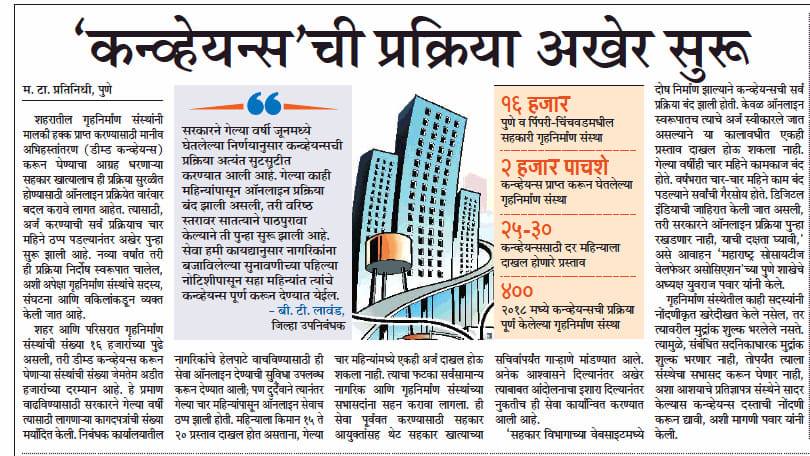 Courtesy : Amend Maharashtra Apartment Act – Flat Buyers Group on Facebook
Here is the link to step by step guide to online submission for DC – Click Here
Courtesy : Binoy Gupta
QUESTIONS AND ANSWERS RELATED TO PROPERTY CARD
Q1. What is a Property Card?
Ans: A property card provides information about the ownership of a property and history of holdings of a land located in urban area. If you are planning to buy a land in urban area, it is essential that you check the property card of the seller and ensure his/her ownership of the land. Even if you are planning to buy a flat, you may want to check the ownership of the land on which the apartment is being constructed. This will help you avoid any hassle in future. Most of the developers, local governing bodies and investors seek property card of the owner before closing a deal. This document is also used in court litigations related to land within city limits.
Q2. Details included in Property Card?
Ans. The Property Card contains almost all the information about a Property such as the:
- Name of the land owner
- Survey number of the land
- Area of the land
- Location
- Changes in ownership
- Details of loans taken by the owner from government agencies
- Details of pending litigations, if any.
- Details of tax levied on the land. This includes paid and unpaid taxes.
Q3. What are the uses of Property Card?
Ans.
- Evidence of the land ownership. In urban area, this card is used to check the ownership of a particular property.
- Details of past transactions and disputes (if any) .
Q4. How to obtain Property Card?
Ans. Property owners are required to approach the City Survey office to get the property card for their properties. However, in recent times the government has made it possible to get property cards with a single click of the mouse. Property cards for all land properties are available online. This enables property owners to avoid the time consuming process of applying through city survey office.
Q5. What is the difference between the 7/12 extract and property card?
Ans: In Maharashtra State Property Card is for Urban Area and 7/12 utara for land in rural area. Both are title cards city survey for residential property and 7/12 for agricultural lands. The 7/12 extract is a record of a land property in a rural area, ownership of the property and type and purpose of the land. This mainly deals with areas that are outside city limits. Property cards contain information about a specific property in urban area and its ownership. Making land records available online will help reduce fraudulent activities, settle ownership or other land related disputes and maintain an updated public record.
7/12 extracts for the entire state of Maharashtra were made available online in 2006. Computerizing property cards and making it available online for all the districts in Maharashtra is still in progress and is estimated to cost around Rs. 25 crores. This project includes computerizing all 7/12 extracts and property cards in 358 taluks of 35 districts and training government officials on hardware, software, data entry, verification and validation of records.
This project is expected to be completed in 2015 and will enable you to obtain land related records and update land related documents from the comfort of your desk. Though this is a welcome move by the government that enables transparency and reduces time wasted on official processes, implementing the project across the state, mainly in rural areas, and training users and employees on the system will be a huge challenge.
Q8. What is City Survey & Property Registration Card?
Ans. The City Survey of Mumbai Suburban District has been carried out during the period 1963-67.
The City Survey Record is prepared for all the villages in Mumbai suburban District.
The City Survey Record for each individual parcel of land has been created and given in particular number.
A property card for each City Survey Number is also prepared.
Q9. What does Property Registration Card contains?
Ans. The Property Registration Card contains the following details:
| Property Card | ||||
| Village | Taluka | District Mumbai Suburban District | ||
| CTS No.. | Area | Tenure | Particulars of assessment or rent paid to Government and when due for revision | |
| Easements:- | ||||
| Holder in origin of the title (so far as traced) | ||||
| Lessee– | ||||
| Other encumbrances | ||||
| Other remarks | ||||
| Date | Transaction | Volume No. | New Holder (H) Lessee (L) or Encumbrances (E) |
Attestation |
| 1 | 2 | 3 | 4 | 5 |
The names of the Holders are only incorporated if the property is non-agricultural. If the property is agricultural, only tenure is mentioned as agricultural in P.R.C. When the property is converted in N.A. the holder name can be incorporated in the P.R. Card after producing necessary documents by the Applicant .
Q10. How many City Survey Offices In Mumbai Suburban from where property card can be obtained?
Ans: In Mumbai Suburban District there are three Talukas viz Kurla, Andheri and Borivali, consisting of total 86 villages. City Survey of these 86 villages were done by 10 City Survey Offices.
Q11. What is the Jurisdiction of each city survey office where property card can be obtained?
Ans: The Jurisdiction of Each City Survey Office is as given below:
| Taluka Kurla | |||
| CTSO Mulund | CTSO Ghatkopar | CTSO Chembur | CTSO Kurla |
| Kopari | Asalpha | Anik | Kurla |
| Kanjur | Kirol | Chembur | Mohili |
| Tirandaj | Ghatkopar | Turbhe | Saki |
| Nahur | Ghatkopar-Kirol | Borla | |
| Pawai | Chandivali | Mankhurd | |
| Paspoli | Tungao | Maravali | |
| Bhandup | Deonar | Mandale | |
| Mulund | Vikroli | Vadhavali | |
| Hariyali | Mahul | ||
| Taluka Andheri | ||
| CTSO Andheri | CTSO Bandra | CTSO Vile-Parle |
| Andheri | Bandra | Vile-Parle |
| Ismalia | Parighakhar | Gundavali |
| Ambivali | Kole-Kalyan | Kondivata |
| Bandivali | Bapnala | |
| Madh | Chakala | |
| Majas | Juhu | |
| Mogara | Bramhanwada | |
| Versova | Parjapur | |
| Oshivara | Marol | |
| Mulgaon | ||
| Vyarvali | ||
| Sahar | ||
| Taluka Borivali | ||
| CTSO Borivali | CTSO Goregaon | CTSO Malad |
| Borivali | Aksa | Aarey |
| Kandivali | Akurli | Kurar |
| Eksar | Erangal | Klerabad |
| Dahisar | Daravali | Goregaon |
| Gorai | Pahari-Eksar | Gundgaon |
| Manori | Pahari-Goregaon | Chichavali |
| Magathane | Poisar | Tulsi |
| Mandpeshvar | Malavani | Dindoshi |
| Shimpoli | Marve | Sai |
| Charkop | Valanai | Malad |
| Kanheri | Wadhavan | |
Along with the above CTSO’s there is an independent Office of the Taluka Inspector of Land Records, Mumbai Suburban District. The Superintendent of Land Records is the controlling authority of all the CTSO’s and the Taluka Inspector of Land Records.
Websites :
1) www.indiarealestateforums.com
2) mumbiasuburban.gov.in/html/land_records.htm#citysurvey
MAHARASHTRA LAND REVENUE CODE RELATED TO PROPERTY CARD
MAHARASHTRA LAND REVENUE
(VILLAGE, TOWN AND CITY SURVEY)
RULES, 1969
Property card – The final results of the enquiry shall be recorded for each parcel of land separately in a card in Form ‘D’ to be called the ‘Property Card’
Survey fees :– (1) The survey fees payable under Section 127 shall ordinarily be so fixed by the Collector that the total sum payable in respect of the site under survey shall cover the cost of the survey and preparation of the Property Card thereof. |
||
| (2) | In fixing the fees for each building site or any portion thereof held separately, the Collector shall have regard to the provision of sub-rule (1) and to the position, value and area of such building site or portion thereof. | |
Maharashtra Land Revenue Record of Rights and Registeres (Preparations and Maintaince) Rules, 1971
Form of record of rights and register of mutations-
In areas surveyed under Section 126, a record rights and register of mutations shall be prepared in the form of “Property Card” prescribed by Rule 7 of the Maharashtra Land Revenue (Village, Town and City Survey) Rules, 1969 and maintained as provided in Rules 21 to 28.
Entries in register of mutations:-
The reports and intimations of acquisition or transfer received by the Talathi under sub-section (1) of Section 150 shall be entered by him in the Property Card.
Notice of mutation:-
As soon as a mutation is entered in the Property Card under Rule 23, the Talathi shall post up a complete copy of the entry in the Village Chavdi or where there is no Chavdi in a conspicuous place in the Village, Town or City. He shall also simultaneously give notice in Form IX to all persons appearing from the Property Card to be interested in the mutation and to any other person whom he has reason to believe to be interested therein, requiring them to send their objections, if any, to the entry either orally or in writing within fifteen days from the date of receipt of such notice.
Disposal of disputes and certification:-
The disputes entered in the register of disputed cases shall be decided and the mutations in the Property Card certified by a revenue or survey officer not below the rank of an Aval Karkun in the manner provided in Rule 17.
Transfer of existing record of rights to Property Card:-
The existing record of rights referred to in Section 159 of such villages, towns and cities as may be specified by a revenue or survey officer not below the rank of the Collector in this behalf, shall be transferred to the Property Card in accordance with the provisions of the Code and these rules; and if it has not been so prepared or maintained, cause it to be so prepared and maintained.
Shared by
Sampat’s Law Firm
Advocate Vinod Sampat
Proprietor
Advocate Heena Vinod Sampat Advocate Dharmin Vinod Sampat Advocate Mithil Vinod Sampat
Mob. 9987622225/7021919950
Email vinod@vinodsampat.com
Circular – To handle the complaints regarding members not paying monthly maintenance charges
Circular – To handle the complaints regarding members in the co-operative housing society not paying monthly maintenance charges. There complaints must not be entertained by Registrar. Copy has to be placed in a conspicuous place by Registrar in his office. If a defaulter is lodging a complaint than chs must use the above circular.
Dated 2nd Nov, 2002
To handle the complaints regarding members in the co-operative housing society not paying monthly maintenance charges.
Maharashtra State Co-operation and Textile Department – Government circular No. SAGUYO – 2002 / PRA.KRA. 365 / 14.SA, Mantralaya extension, Mumbai – 4000032.
Date: – 02 November 2002
CIRCULAR
It came to the notice of the government that, some members in the co-operative housing societies are not paying monthly dues to the society. And for this they are giving various reasons like amount of members is due from the society, society is not repairing the flat, monthly charges are higher etc. Thereby the managing committee of the society is facing difficulty in doing day-to-day work of the society.
When Managing Committee seek justice to the Registrar under Maharashtra co-operative societies Act 1960, the members state that their complaint is pending with government / Registrar and therefore payment was not paid.
While taking into account the difficulties facing by the managing committees due to not paying monthly charges, the following instructions are being issued for how to handle such cases by the Registrar.
- The members should not stop paying monthly maintenance charges to the society for any reason.
- If there are some differences of any members with the Managing Committee regarding monthly maintenance charges then they should solve them by applying to the Competent Authority. The Registrar should take precaution of deciding the complaint regarding monthly maintenance charges within one month of receipt.
- If the Competent Authority certified that the monthly maintenance charges are higher than the action to return/ adjust in the monthly maintenance charges should be taken by the managing committee of the society as per order issued by the Competent Authority.
- While taking cognizance of the complaint of the members who stopped payment of monthly charges, the Registrar should first instruct such members to pay the dues of the society first.
- The copy of this circular should be put up on the notice board in the office of the Registrar.
- This circular should be brought to the notice of all the Dy. Registrar/ Assistant Registrar all District Deputy Registrar. Similarly the Dy. Registrar, Co-operative Societies should take action in bringing to the notice to the Federation of Housing Co-operative Societies in the state.
By order and in the name of Governor of Maharashtra.
sd/- Section Officer, Government of Maharashtra, Co-operative & Textile Department.
Shared by
Sampat’s Law Firm
Advocate Vinod Sampat
Proprietor
Advocate Heena Vinod Sampat Advocate Dharmin Vinod Sampat Advocate Mithil Vinod Sampat
Mob. 9987622225/7021919950
Email vinod@vinodsampat.com
Leakage in Co operative Housing Societies.
It is common knowledge that many disputes in Co operative Housing Societies originate on account of Leakage. Prima facie leakages are of two types internal  leakage and external leakage.
We all know that water percolates from top to bottom. It reduces the life span of the building. The neighbour from whose flat leakage originates is hardly bothered as leakage does not affect him.
The poor member residing on the lower floor pleads, appeals, screams but hardly does it affect the member residing above his flat.
His submission that his furniture is getting spoilt. False ceiling is likely to fall, the paint is peeling, walls have become wet, There is a probability of electrical shocks due to water percolating into wall are just ignored by the member residing above. The submissions being made by the society in such matters almost falls on deaf ears.
Forget about repairing the flat and stopping the leakage, Member residing on the above floor literally does not allow the society representatives or the representative of the members residing below to even allow the contractor to enter his flat.
Some societies have passed resolution that the expense on leakage of flat specifically internal leakage will be shared equally by all the three parties namely, one share by the member from whose flat leakage is originating, one share by the member residing below that is the sufferer ( dukhi atma ) and one share by the society. Idea of sharing by the society is to ensure an element of support to the sufferer besides an element of fear on the member who is resisting carrying out leakage.
As regards external leakage or leakage from the terrace the same is the exclusive responsibility of the society.
Here, I would like to add that the members are short-sighted at times due to vested interest they oppose sharing of expenses. Let’s take an example
We know that leakage will result in contribution of expenses by the members residing on the lower floors. Say the society collects Rs. 1,000/- per member per month for repair and maintenance. The members on the top floor also pays Rs. 1,000 for repairs. Terrace repair contribution for resolving the leakage problem would be say Rs. 5,00,000/-. Why should the hefty expenses be incurred by all when more benefit is likely to accrue on a selected few? This is the logic of members residing on lower floors.
The aggrieved member much against his desire has to approach lawyer for such matters. Obviously his lawyer will think in terms of the welfare of his clients and will take the fight to a different level. He will advise his client to approach Bombay Municipal Corporation and write to the Bombay Municipal Corporation to issue notice to the society as well as a member residing above his flat. He may also advise his client to draw the attention of the Bombay Municipal Corporation to the irregularities and illegalities in the cooperative society. We have been given to understand that the Bombay Municipal Corporation itself is not following laws framed by the Bombay Municipal Corporation then how are Cooperative Societies supposed to follow the said laws100%? Nitch area, drying space area are merged and misused by many members of a cooperative society which is an open secret.
Terrace repairs is the responsibility of the society. But in reality members residing on top floors have to contribute extra is the unwritten rule for repairs of terrace. Alternatively suffer in iisolation. Members in general body meeting will say just put tar by spending a few thousand rupees rather than repair the terrace.
In one matter of internal leakage Bombay High Court has also advise all the parties to resolve the issue amicably. That too after telling the cooperative society that the court would be forced to appoint an administrator to sort out the issue of leakage.
We are herewith annexing a few newspaper articles and judgements on leakage related matters.
Compiled and Shared by
Sampat’s Law Firm
Advocate Vinod Sampat
Proprietor
Advocate Heena Vinod Sampat Advocate Dharmin Vinod Sampat Advocate Mithil Vinod Sampat
Mob. 9987622225/7021919950
Email vinod@vinodsampat.com

Newspaper Article regarding Leakage in Flat (1)
1188 WATERPROOFING CASEPKB VS RNA ORDER DATED 03 12 2014 leakage
378 HUMBLE HOME CHS LTD VS SHAM BALANI final.doc
994 LEAKAGES COURT JUDGMENTS.docx
Leakage in Co operative Housing Societies (1)
Flat buyer can claim refund if he doesn’t get possession in time
Rajesh Sharma had applied for a flat in Purab Premium Apartments being constructed by the Greater Mohali Area Development Authority (GMADA). He paid Rs 6,90,000 along with his application.
Subsequently, a Letter of Intent (LoI) was issued on May 22, 2012, promising possession within 36 months. Sharma paid Rs 58,65,000 more as demanded.
The Authority failed to deliver possession within the promised period. So Sharma sent a letter on July 1, 2016 seeking a refund of the entire amount paid by him, but his request was ignored.
Instead, a letter backdated June 30, 2016, was sent on July 4, 2016, offering possession of the apartment, but Sharma did not take possession. After a few months, the Authority sent a letter agreeing to refund the money without interest, subject to a deduction of
10% of the total price paid.
Sharma then filed a complaint before the Punjab State Commission, which was contested by the Authority.
The Commission overruled the objection raised by the Authority that the dispute should be referred to arbitration or a civil court, and held the consumer fora were competent to adjudicate the dispute. It concluded a consumer who is not given possession in time has a right to seek a refund. Accordingly, it directed the Authority to refund the entire amount along with 8% compound interest. In addition, Rs 50,000 was awarded as compensation and Rs 21,000 as litigation costs.
The Authority appealed against this order. The National Commission scrutinized the postal receipts and the envelopes and found the letter sent by the Authority had been despatched on July 4, 2016, but had been backdated to June 30, 2016, to make it appear it was sent a day prior to Sharma’s letter dated July 1, 2016.
Accordingly, by its order of January 2, 2019, delivered by the bench of Justice R K Agrawal and Justice M Shreesha, the National Commission dismissed the Authority’s appeal.
Conclusion: A flat purchaser can seek a refund along with interest and compensation if possession is delayed. Such a demand could be made at any time prior to the issuance of letter offering possession.
(The author is a consumer activist and has won the Govt.of India’s National Youth Award for Consumer Protection. His email is jehangir.gai.columnist@outlook.in )
Jehangir B Gai
ePaper, The Times of India, Bombay, Monday, January 07, 2019, Page 4:

