Housing society is promoter for redevelopment of its buildings

Kamlesh Bhuvan CHS in Chembur had entered into a redevelopment agreement with Mahavir Enterprises for redeveloping its dilapidated building. There was also a tripartite agreement between the society, each member and the builder for allotment of flats in the re-developed building. It was agreed that each member would get additional space of 20% in the new building. The society also took a bank guarantee of Rs 50 lakh from the builder.

However, the builder defaulted in handing over possession of the flats on time and also failed to pay compensation for alternate accommodation for the period of delay. A member of the society Padam Chandiramani, filed a complaint before the Additional Mumbai Suburban District Forum against the builder—Mahavir Enterprises—through its partners D Gala and K Shah as well as against the housing society.

The builder contested the complaint. He stated that the keys to the flats of all the original 12 members, including Chandiramani, had been handed over to the society but the society had failed to hand over possession to its members. He argued the society had an obligation to ensure that all its members would get possession of the flats within 24 months, but had failed to do so. The society did not care to contest the case.

The forum held that the builder as well as the society were jointly and severally liable to put Chandiramani in possession of her flat, and ordered delivery of the flat within two months. Additionally, the builder was also ordered to pay compensation at the agreed rate of Rs 25 per sq ft per month along with 10% interest. Further, litigation costs of Rs 5,000 were awarded.

The builder and the society challenged this order in appeal. The state commission observed a co-operative housing society would come within the ambit of the definition of a promoter, developer and builder as it has promised it give possession of flats to its members in the redeveloped building.

Accordingly by its order delivered on April 12 by Justice A P Bhangalae for the bench along with Usha Thakare the Maharashtra State Commission modified the order passed to apportion the liability between the builder and the society If held that the builder would be liable to pay Rs 25 per sq ft to Chandirarmani for the period of delay till the date of handing over keys to the society, and thereafter, the society would be liable to pay the same amount of compensation for its failure to put Chandiramani in possession.

Jehangir Gai

(The author is a consumer activist and has won the Govt. of India’s National Youth Award for Consumer Protection. His e-mail is jehangir.gai.columnist@outlook.in)

Click Here for the full order

‘Food items and bottled water should be sold at regular prices inside multiplexes’

The Bombay High Court has ruled that food items and bottled water be sold at regular prices inside multiplexes. The directive was issued by a division bench of Justices S.M. Kemkar and M.S. Karnik last week in response to a Public Interest Litigation (PIL) filed by Mumbai resident Jainendra Baxi. He had challenged the prohibition on carrying outside food in movie theatres and multiplexes across Maharashtra, according to the Economic Times.
Justice Kemkar observed: “The price of food and water bottles sold inside movie theatres are, indeed, exorbitant. We have ourselves experienced it. You (multiplexes) should sell it at the regular price.”
The court said that if multiplexes were prohibiting people from bringing outside food, then there should be a total prohibition on eatables. “Then you (multiplexes) cannot have your own vendors selling food and other snacks inside,” said Justice Kemkar.
The government pleader, Purnima Kantharia, told the court that the state would soon frame a policy on the issue, after taking into consideration the suggestions of the petitioner and the Multiplex Owners’ Association (MOA). The MOA is a nationwide body of cinema theatre owners. The policy is likely to be framed within the next six weeks, she told the court. The bench will now hear the petition on 12th June.

Consumer confidence has waned since December 2017 – RBI Survey

Consumer confidence has waned since December 2017 with respondents to an RBI survey being more pessimistic about the current economic situation and employment opportunities compared to a year ago. The only area where sentiment is in the optimistic zone is in spending on essential and non-essential items, according to a report in the Economic Times.
“Households’ current perceptions on the general economic situation dived sharply from the neutral level polled in the last round. Their one-year-ahead outlook also deteriorated, but remained in the optimistic domain,” the RBI said in a statement. What this means is that while most people believe that economic growth will pick up in 12 months, there are fewer people feeling that way compared to earlier.
“Respondents continued to express concern about the current employment situation, and outlook for the year ahead was less positive than in the previous round,” the RBI said. Households’ assessment of the current price situation and the outlook a year ahead has broadly remained unchanged.
The responses to the survey had gone into pessimist territory from June 2013 when the rupee had crashed during the ‘Taper Tantrums’. After that, they have been largely optimistic since March 2013. They slipped back to pessimism again in the quarter following demonetisation in November 2016 and have been there ever since, according to the Economic Times.

https://advisor.moneylife.in/article/consumer-confidence-has-waned-since-december-2017-and-ndash-rbi-survey/2666.html

Landmark Judgement on Transfer Charges

Please find herewith land mark judgment delivered on 10-4-2018 pertaining to refund of transfer charges by Bombay High Court with interest. Basically Transfer of flat is a contract between outgoing and incoming member. Just to have involvement of the society in the earlier years RS. 1/- was charged as transfer Fee. Now transfer fee is RS. 500/- and maximum amount collected under share premium account is RS. 25,000/-

For Co-operative Societies Residents Users & Welfare Association.

President
Adv Vinod Sampat

⭐😀HC says the demand of admission fees in sum of 5 % of the sale price for purpose of admitting a new member against purchase of a flat, has no legal sanction or propriety under the scheme of MCS Act, Rules and Byelaws to be framed thereunder..⭐

⭐Membership of chs is an open membership. It is not possible to put any restriction on such membership save and except as may b provided undr Act, Rules, Byelaws made consistently with the Act and Rules.. section 23(1) of MCS prohibits any society from refusing membership duly qualified under mcs rules and byelaaws of such society for such membership without sufficient cause.. if any person were to be refused admission on account of certain fee or charge, such fee or charge must be legally justified so as to give rise to sufficient cause. If any person were to be refused payment of such fee or charge, in other words, so as to amt a sufficient cause, must hav a sanction of law.. the particular GBR dated 7th Jan 1993, which autborizes society to charge a sum of 5 % of sale price of flat as admission fee for the purpose of new membership has no legal sanction. There is no such provision in d Act or the Rules or indeed in the byelaws of the society in the present case, which enables the society to pass such GBR..⭐

In law, it.must be shown that the society, which is a creature of statute, has the power to take particular action complained of witjin d framedwork of such statute or otherwise under law..

⭐What is important in law is not the identity of the person, who actually makes payment but d identity of the person on whose behalf the payment is made. It is very clear from resolution of the society that this payment is in the nature of admission fee for the purpose of admitting new members against purchase of flat in the society. In other words, it is a charge to be levied on new member.. it is immaterial who makes this payment.. such payment has no sanction of law and wrongly recoverd frm new member. It is wholly immaterial who made this payment willingly or under protest. As long as it is money wrongly paid, it can be recovered by the payer from the payee within the period of limitation..

There is nothing to suggest that this payment was made voluntary by new member and hav taken the advantage of this payment.. thid is also not a case of voluntary donation..

There is no doubt that the period of limitation in such case is years from the date on which the act or omission with reference to which the dispute arose took place section 92(1)(b) of Limitation Act 1963.. As this dispute is related to an act or omission on the part of the society against the member⭐😀👇👇


Click Here for the full judgement

New Income-tax Return Forms for non-profits – Huge data mining exercise on part of the Government of India

The Central Board of Direct Taxes (CBDT) has notified the Income-tax Return (ITR) Forms applicable for the Assessment Year 2018-19. These ITR Forms will be applicable for filing income-tax return in respect of income earned during the period 1st April 2017 to 31st March 2018. The new forms incorporate the changes made by the Finance Act, 2017 in the Income-tax Act, 1961. It is apparent that the new ITR Forms have shifted the entire onus on the taxpayers to prove their claim for deductions, expenses or exemptions.

Form ITR 7 (Applicable to trusts and charitable institutions)

Trusts and institutions established for charitable purpose are required to file their annual income-tax Return in ITR 7. Aadhar number of trust functionaries like trustees must be disclosed as also amount of foreign contributions received and for what purpose. In our view, there is a huge data-mining exercise on part of the Government of India.

It is mandatory for a trust or charitable institution to file return of income electronically with or without digital signature. A trust may also file return of income under Electronic Verification Code. However, a trust liable to get its accounts audited under section 44AB shall furnish the return electronically under digital signature.

Trusts & charitable institutions to disclose more information in ITR 7

Charitable or religious trusts filing income-tax return for the Assessment Year 2018-19 (Financial Year 2017-18) in Form ITR 7 shall be required to disclose following additional information:

  • Aggregate annual receipts of the projects/institutions run by the trust. However, the table asking details about the name and annual receipts of institutes covered under Sections 10(23C)(iiiab), (iiiac), (iiiad) and (iiiae) has been removed.
  • Date of registration or approval granted to the trust.
  • Amount utilized during the year for the stated objects out of surplus sum accumulated during an earlier year.


Details of fresh registration upon change of objects (Section 12A)

Section 12A provides for conditions to be satisfied by a charitable institution for availing of exemption under sections 11 and 12. A new clause (ab) has been inserted in Section 12A(1) with effect from Assessment Year 2018-19 to provide that where a charitable institution has been granted registration and, subsequently, it has adopted or undertaken modification of the objects which do not conform to the conditions of registration, it shall be required to take fresh registration. Consequential changes have been made in the Form ITR 7. A trust will be required to furnish the following details if there is any change in its stated objects:

  1. Date of change in objects
  2. Whether application for fresh registration has been made within stipulated time period?
  3. Whether fresh registration has been granted?
  4. Date of such fresh registration.

No deduction for corpus donations made to other institutions (Section 11)

Up to Assessment Year 2017-18, a donation made by a registered trust to another registered trust constituted application of income notwithstanding that the donation was made with a specific direction that it shall form part of the corpus of the donee. The Finance Act, 2017 has inserted a new Explanation 2 with effect from Assessment Year 2018-19 to effect that any donation to another charitable institution registered under section 12AA with a specific direction that it shall form part of the corpus of the donee, shall not be treated as application of income for charitable or religious purposes.

The consequential changes have been made in form ITR 7. In Schedule TI (Statement of Income) all the corpus donations made by a trust to another registered trust shall be added back to the taxable income of the donor trust.

Due date & penalty

A trust which is required to get its accounts audited under the Income-tax Act or under any other law, the due date is September 30 of the relevant assessment year.

Finance Act, 2017 has levied new fees if an Assessee does not furnish the return of income on the due dates prescribed under Section 139(1). The amount of such late filing fees shall be: INR 5,000 if return is furnished after the due date, but, before December 31 of the assessment year (INR 1,000 if total income is up to INR 5 lakhs) and INR 10,000, in any other case.

After introducing this new provision, the Assessee shall now be required to pay the late filing fees under section 234F along with interest under section 234A, 234B and 234C before filing of return of income. The Income-tax department shall not be required to initiate the penalty proceedings separately to levy such fees on late filers. Relevant changes have been incorporated in the new ITR forms wherein a new row is added to enable the Assessee to fill the details of late filing fees.

View latest ITR 7 at:

https://www.incometaxindia.gov.in/forms/income-tax%20rules/2018/itr7_english.pdf

https://capnewsviews.blogspot.in/2018/04/new-income-tax-return-forms-huge-data.html?m=1

A people’s movement to fight drought

Paani Foundation is a not-for-profit company set up in 2016 by the team of the TV series Satyamev Jayate to fight drought in rural Maharashtra. Water scarcity is largely a man-made condition, and we believe that only people’s efforts can solve the crisis. Paani Foundation aims to harness the power of communication to mobilise, motivate and train people in this mission to eradicate drought. Offering training in scientific watershed management, leadership and community-building, Paani Foundation is now working in roughly 90% of drought-hit Maharashtra. Our flagship project, the Satyamev Jayate Water Cup was instituted in 2016 as a way to encourage villages to apply their training in watershed management. Water Cup 2018 will be held from 8th April to 22nd May 2018.

https://www.paanifoundation.in/


Bank liable for reneging on settlement of dues

Case Study: Ajay Singh Chauhan took a loan from Citibank. He defaulted in making payments of some EMIs. On 27th April, 2007, the bank offered a structured repayment plan for settlement of the entire dues. As per the offer, the entire outstanding would be considered as settled on payment of Rs 40,000, provided the amount was paid by the following day and Chauhan paid the amount the same day.

On 21st May, 2008, Citibank sent a letter demanding a further payment of Rs 30,000. On being questioned, the bank said its dues could not be considered as having been settled since Chauhan had not returned a signed copy of the bank’s letter accepting its offer.

Chauhan then filed a complaint before the Jaipur District Forum alleging deficiency in services and the complaint was contested by the bank. The forum upheld the complaint and ordered a “no dues” certificate to be issued. Further, considering the bank’s conduct, Citibank was ordered to pay Rs 10 lakh, out of which Rs 1 lakh would go to Chauhan as compensation for harassment and mental agony. The remaining 

Rs.9 lakh was meant for the Rajasthan State Consumer Welfare Fund. In addition, Chauhan was also awarded Rs 20,000 towards litigation costs.

The bank challenged this order before the Rajasthan State Commission but its appeal was dismissed. Citibank then filed a revision petition, contending Chauhan was a perpetual defaulter in paying EMIs.

The National Commission observed that the question of being a habitual defaulter was not relevant, as the issue was about the validity of the settlement. The commission noted there was no dispute about Chauhan having paid Rs 40,000 within the time given in the offer. The commission held Citibank’s demand for a further amount, made after more than a year, was not justified and did not behove a bank of its stature.

On 6th March, the commission held Chauhan was entitled to get a “no dues” certificate. It also considered the award of Rs 1 lakh as compensation and Rs 20,000 towards cost payable to Chauhan was justified. However, the penal compensation payable to Rajasthan State Consumer Welfare Fund was reduced to Rs 50,000/.

Conclusion: A bank cannot renege from its settlement offer when the borrower clears dues in the stipulated period.

Jehangir B Gai

ePaper, The Times of India, Bombay, April 2, 2018, Page 4:

(The author is a consumer activist and has won the Govt. of India’s National Youth Award for Consumer Protection. His email is jehangir.gai.columnist@outlook.in)

Inventor Introduces New Technology for Fast-Charging, Noncombustible Batteries

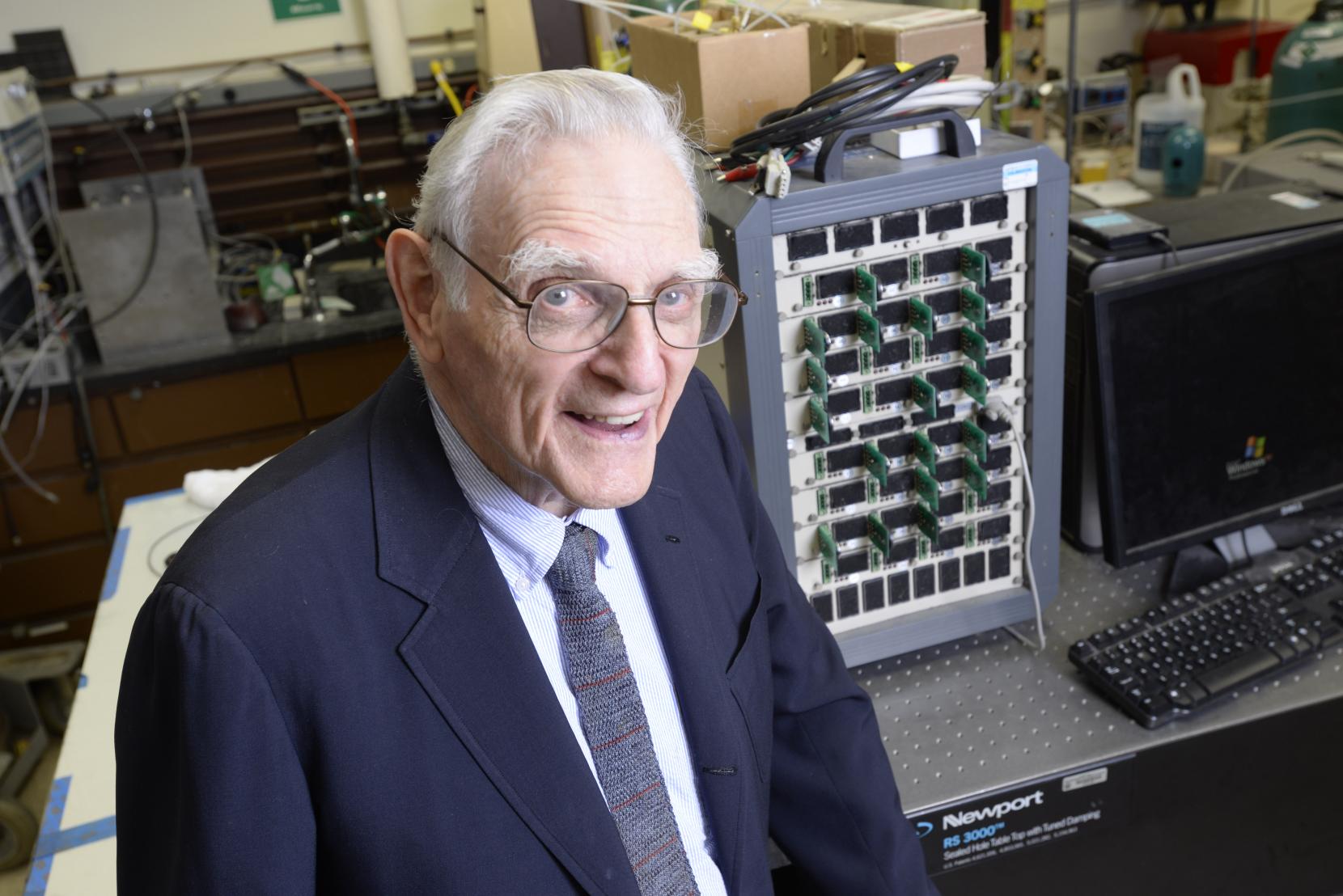
AUSTIN, Texas — A team of engineers led by 94-year-old John Goodenough, professor in the Cockrell School of Engineering at The University of Texas at Austin and co-inventor of the lithium-ion battery, has developed the first all-solid-state battery cells that could lead to safer, faster-charging, longer-lasting rechargeable batteries for handheld mobile devices, electric cars and stationary energy storage.

Maria Helena Braga

Pictured: Maria Helena Braga.

Goodenough’s latest breakthrough, completed with Cockrell School senior research fellow Maria Helena Braga, is a low-cost all-solid-state battery that is noncombustible and has a long cycle life (battery life) with a high volumetric energy density and fast rates of charge and discharge. The engineers describe their new technology in a recent paper published in the journal Energy & Environmental Science.

“Cost, safety, energy density, rates of charge and discharge and cycle life are critical for battery-driven cars to be more widely adopted. We believe our discovery solves many of the problems that are inherent in today’s batteries,” Goodenough said.

The researchers demonstrated that their new battery cells have at least three times as much energy density as today’s lithium-ion batteries. A battery cell’s energy density gives an electric vehicle its driving range, so a higher energy density means that a car can drive more miles between charges. The UT Austin battery formulation also allows for a greater number of charging and discharging cycles, which equates to longer-lasting batteries, as well as a faster rate of recharge (minutes rather than hours).

Today’s lithium-ion batteries use liquid electrolytes to transport the lithium ions between the anode (the negative side of the battery) and the cathode (the positive side of the battery). If a battery cell is charged too quickly, it can cause dendrites or “metal whiskers” to form and cross through the liquid electrolytes, causing a short circuit that can lead to explosions and fires. Instead of liquid electrolytes, the researchers rely on glass electrolytes that enable the use of an alkali-metal anode without the formation of dendrites.

The use of an alkali-metal anode (lithium, sodium or potassium) — which isn’t possible with conventional batteries — increases the energy density of a cathode and delivers a long cycle life. In experiments, the researchers’ cells have demonstrated more than 1,200 cycles with low cell resistance.

Additionally, because the solid-glass electrolytes can operate, or have high conductivity, at -20 degrees Celsius, this type of battery in a car could perform well in subzero degree weather. This is the first all-solid-state battery cell that can operate under 60 degree Celsius.

Braga began developing solid-glass electrolytes with colleagues while she was at the University of Porto in Portugal. About two years ago, she began collaborating with Goodenough and researcher Andrew J. Murchison at UT Austin. Braga said that Goodenough brought an understanding of the composition and properties of the solid-glass electrolytes that resulted in a new version of the electrolytes that is now patented through the UT Austin Office of Technology Commercialization.

The engineers’ glass electrolytes allow them to plate and strip alkali metals on both the cathode and the anode side without dendrites, which simplifies battery cell fabrication.

Another advantage is that the battery cells can be made from earth-friendly materials.

“The glass electrolytes allow for the substitution of low-cost sodium for lithium. Sodium is extracted from seawater that is widely available,” Braga said.

Goodenough and Braga are continuing to advance their battery-related research and are working on several patents. In the short term, they hope to work with battery makers to develop and test their new materials in electric vehicles and energy storage devices.

This research is supported by UT Austin, but there are no grants associated with this work. The UT Austin Office of Technology Commercialization is actively negotiating license agreements with multiple companies engaged in a variety of battery-related industry segments.

Top bottled water brands contaminated with plastic particles

Plastic was identified in 93 percent of the samples included in the study, which included major name brands such as Aqua, Aquafina, Dasani, Evian, Nestle Pure Life and San Pellegrino

The world’s leading brands of bottled water are contaminated with tiny plastic particles that are likely seeping in during the packaging process, according to a major study across nine countries published Wednesday.

“Widespread contamination” with plastic was found in the study, led by microplastic researcher Sherri Mason of the State University of New York at Fredonia, according to a summary released by Orb Media, a US-based non-profit media collective.

Researchers tested 250 bottles of water in Brazil, China, India, Indonesia, Kenya, Lebanon, Mexico, Thailand, and the United States.

Plastic was identified in 93 percent of the samples, which included major name brands such as Aqua, Aquafina, Dasani, Evian, Nestle Pure Life and San Pellegrino.

The plastic debris included polypropylene, nylon, and polyethylene terephthalate (PET), which is used to make bottle caps.

“In this study, 65 percent of the particles we found were actually fragments and not fibers,” Mason told AFP.

“I think it is coming through the process of bottling the water. I think that most of the plastic that we are seeing is coming from the bottle itself, it is coming from the cap, it is coming from the industrial process of bottling the water.”

Particle concentration ranged from “zero to more than 10,000 likely plastic particles in a single bottle,” said the report.

On average, plastic particles in the 100 micron (0.10 millimeter) size range — considered “microplastics,” — were found at an average rate of 10.4 plastic particles per liter.

Even smaller particles were more common — averaging about 325 per liter.

Other brands that were found to contain plastic contaminated included Bisleri, Epura, Gerolsteiner, Minalba and Wahaha.

Experts cautioned that the extent of the risk to human health posed by such contamination remains unclear.

“There are connections to increases in certain kinds of cancer to lower sperm count to increases in conditions like ADHD and autism,” said Mason.

“We know that they are connected to these synthetic chemicals in the environment and we know that plastics are providing kind of a means to get those chemicals into our bodies.”

– Time to ditch plastic? –

Previous research by Orb Media has found plastic particles in tap water, too, but on a smaller scale.

“Tap water, by and large, is much safer than bottled water,” said Mason.

The three-month study used a technique developed by the University of East Anglia’s School of Chemistry to “see” microplastic particles by staining them using fluorescent Nile Red dye, which makes plastic fluorescent when irradiated with blue light.

“We have been involved with independently reviewing the findings and methodology to ensure the study is robust and credible,” said lead researcher Andrew Mayes, from UEA’s School of Chemistry.

“The results stack up.”

Jacqueline Savitz, chief policy officer for North America at Oceana, a marine advocacy group that was not involved in the research, said the study provides more evidence that society must abandon the ubiquitous use of plastic water bottles.

“We know plastics are building-up in marine animals, and this means we too are being exposed, some of us, every day,” she said.

“It’s more urgent now than ever before to make plastic water bottles a thing of the past.”


https://www.afp.com/en/news/2265/top-bottled-water-brands-contaminated-plastic-particles-report-doc-12j5ev1