
Category: Co-operative Societies
Ready Reckoner & Market Value of Properties in Mumbai
Seminar against Corruption
Realm of Law a legal firm headed by Shri K. V. J Rao, along with Petition Group Foundation (an NGO) established to fight corruption in Administration are renowned for fighting against the growing number of corruption cases in redevelopment projects.
Since 2023, we started holding educational seminars to guide Citizens cheated by developers, the last seminar was conducted on 26th May 2024.
Hence, due to the requests from several members, we are organising another seminar on 4th Aug 2024 (Sunday).
Topic covered in the seminar would be:
- Criminal aspects of frauds in Redevelopment Projects and how to address them.
- How to file FIR’s against Developers based on their acts of omissions and commissions.
- Common issues in Society Matters.
A) How to legally fight a corrupt managing committee.
B) How to legally fight corrupt/non cooperating flat owners.
ALONG WITH THE ABOVE SUBJECT WE’RE ALSO ADDRESSING CRITICAL SUBJECT .
We’re having an educative talk given by Shri K. V. J Rao giving guidance and information on how to fight corruption and injustice in public offices. We intend to guide common citizens on HOW to fight corruption and target corrupt public servants indulging in deficiency of duties.
The session is intended to motivate common citizens to fight against the corruption done by public servants. The seminar will educate all on methods to expose and put such public servants to shame.
The topics of interest :-
1] How to file criminal cases against public servants.
2] How best to self represent your cases before the learned Magistrate.
3] How to interpret past judgements before the learned Magistrate to get a conducive order.
4] How to prosecute culprits in your case.
5] To discuss about the success stories of individuals who fought for their own rights and achieved good, favourable orders / replies from various government authorities.
SPEAKERS:
1. Shri. K.V.J. RAO
 Activist and domain expert on criminal law.

2. Shri. AMEET ISRANI
 Expert on Society Matters.
Kindly note that the queries will be taken by prior submission to the organiser (9870392223) and it is the jurisdiction of the organiser to take the matter on board as per relevance to the topic.
Details:
Day, Date and Time :
Sunday, 4.08.2024
9 AM to 6 PM
Venue :
Sarvodaya – Centre for Capacity Building- FIRST FLOOR HALL.
Gate # 3, St. Pius X College Complex,
Off Virwani Industrial Estate Road,
Goregaon (East), Mumbai – 400063
Landmark: Take the IITC Road from Umiyadham Jain Mandir.
Google Map Link: https://goo.gl/maps/TGoShRXT5Tbv6pSC9
LIMITED SEATS FOR 90 PARTICIPANTS ONLY.
Fees: Rs.500 by prior online transfer via Bank Details or UPI ID or scanner barcode.
Arrangements at the Venue:-
1) Breakfast & Tea will be provided.
2) Lunch will be served in the dining hall.
3) Evening Snacks and Tea will be provided.
If interested, then kindly contact on the below mobile number for any enquiry:
Shri. Mahavir Ghongade
9870392223
Shri. Neeraj Pattath
9769767969
Bank details for payment are:
BANK NAME:
Canara Bank
ACCOUNT NAME: Mahaavir Ghongade
ACCOUNT NO:
110105879520
Account Branch:
Canara Bank, Malad East
IFSC CODE: CNRB0002695
UPI ID:
mahaavirghongade@cnrb
Please send the screenshot of the payment or details of payment to the mobile number 9870392223 for confirmation.
Prior registration is compulsory. The organizers reserve the right of admission.
Kindly Note: The registration amount you pay is only for the expenses of the hall rent, tea, snacks, lunch and more importantly the speakers are not soliciting business but rendering Honorarium Services Free of Cost.
Walk-in/gate crashers will not be permitted.
Kindly forward this message to those who may be interested.
Thank You
Realm of Law & Petition Group Foundation.
Maharashtra Co-operative Societies (Amendment) Ordinance, 2024
SC Eviction of a Tenant Cannot Be Ordered Merely Based on a Demolition Notice Issued by the Municipal Body
TDS on transactions of redevelopment of societies
TDS on redevelopment of societies: Generally there are exchange of services in the redevelopment transactions with the societies. Societies are transfer the FSI with the development rights to the developer and developer give them a existing area with some extra area free of cost, corpus, betterment charges, alternate accommodation, may be some maintenance charges for few years after possession etc. in the above transaction, there are lot of FAQ’s and confusions regarding TDS u/s 194IA and 194IC.
Click Here – https://taxguru.in/income-tax/tds-transactions-redevelopment-societies.html
to read the full article
During lifetime of parents, children cannot assert exclusive ownership over parent’s property…
Complaint Redressal Portal for Housing Societies

Objective of Sahakar Samvad Portal
Sahakar Samvad, an initiative by The Maharashtra State Co-operative Housing Federation Ltd., is a dedicated online platform designed to address grievances within the co-operative housing societies of Maharashtra. Our primary objective is to establish a seamless and transparent mechanism through which members, prospective members, and other stakeholders can raise their concerns related to matters falling within the jurisdiction of the Registrar of Co-operative Housing Societies..
Key Features:
Grievance Submission: Sahakar Samvad allows easy and convenient submission of grievances by any member or prospective member of a co-operative housing society. Individuals can provide comprehensive details of their complaint within a concise 200-word description or upload relevant documents up to 1 MB, ensuring clarity and effective understanding of the issue at hand.
Charges and Utilization: A nominal fee of ₹50 is applicable for filing each complaint. The charges collected from members will be utilized for the maintenance and updates of the portal and for providing training and education to members of cooperative housing societies exclusively.
Empowering Co-operative Education: The funds collected through the grievance posting charges will also be utilized to provide co-operative education and training exclusively to the members of housing cooperatives. These educational programs will aim to enhance members’ understanding of the Maharashtra Co-operative Societies Act, 1960, Rules, Byelaws, and other relevant regulations.
Effective Redirection and Monitoring: Once a complaint is submitted on Sahakar Samvad, it will be automatically directed to the concerned Joint/Deputy/Assistant Registrar of Co-operative Societies. Controlling concerned higher officers will actively monitor the complaints, ensuring timely and appropriate actions are taken in response.
Transparent Tracking: Complainants can easily track the status of their grievances at any time, promoting transparency and accountability in the grievance resolution process.
Support from District Federations: District Federations of co-operative housing societies will actively collaborate with Sahakar Samvad. They will provide guidance, support, and essential training to housing societies as required, with the ultimate goal of reducing grievances and fostering a cooperative living environment.
Promoting Co-operative Spirit: Sahakar Samvad will not only serve as a grievance resolution platform but also function as a comprehensive resource hub for co- operative education. It will provide valuable information on co-operative principles, empowering members with knowledge to strengthen their understanding of the co- operative movement.
Our vision for Sahakar Samvad is to build a resilient and united co-operative community that thrives on mutual cooperation, informed decision-making, and effective dispute resolution. By utilizing the grievance posting charges for portal maintenance and educational initiatives, we aim to create a sustainable and self- sufficient platform that benefits the entire cooperative housing society ecosystem in Maharashtra.
Together, we envision a future of harmonious co-operative living in a better and inclusive environment
Redressal Process
A member can submit application of written complaint to any member of the office bearer. After receiving the complaint, the committee will take decision on it in its immediate meeting and thereafter that decision will be communicated to the concerned member within 15 days.
If the concerned member was not satisfied on the decision communicated by the committee, or no contact was made by the committee within 15 days in this regard, then the member of the committee can contact to the complaint redressal committee formed by the Annual General Body Meeting. If a member is not satisfied with composition and powers of such committee, then the complainant member can contact the authorized officers as per nature of the complaint.
To Registrar –
- Registration of Society on misrepresentation
- Non-issuance of the Share Certificates.
- Refusal of Membership.
- No registration of nomination by the society.
- Non-Occupancy charges.
- Demand of excess premium for transfers.
- Non supply of copies of the record and documents.
- Tampering, suppression and destruction of the records of the Society.
- Non acceptance of the cheques or any other correspondence by the committee.
- Non preparation of the annual accounts/reports, within the prescribed period;
- Misappropriation/Misapplication of the funds of the society.
- Investment of funds without prior permission.
- Reconciliation of account.
- Audit
- Non conducting of election before expiry of the term of the committee.
- Rejection of Nomination.
- Non calling of general body meeting within prescribed period.
- Not calling of Managing Committee as prescribed in laws.
- Resignation of the committee.
- Any other, like matters which falls within jurisdiction of the Registrar.
Once online filed your complaint will be directed to the concerned Joint/Deputy/ Assistant Registrar of Co-operative Societies for action and resolution. Rest assured that all complaints will be tracked, monitored, and confirmed by controlling officers to ensure timely action.
Use the “Track Your Complaint” section to monitor the status and progress of your filed complaint. Access real-time updates on the actions taken by the concerned authorities.
A nominal fee of ₹50 is applicable for filing each complaint. The charges collected from members will be utilized for the maintenance and updates of the portal and for providing training and education to members of cooperative housing societies exclusively.
Irregular vs Illegal – Bombay High Court
The latest Bombay High Court Judgement draws a distinction between what is irregular and what is illegal. What is irregular can be regularised while what is illegal cannot be.
Will/Inheritance Law is more important than Nominee
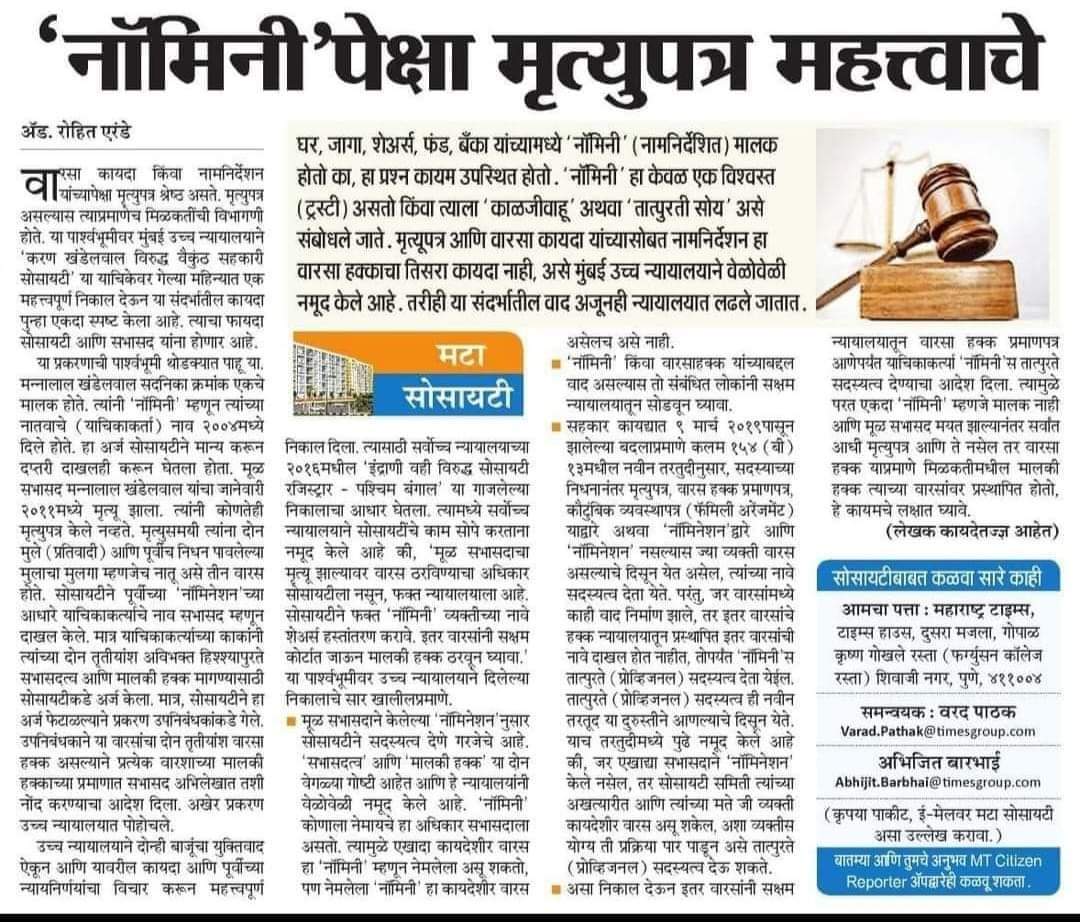
Will is more important than ‘nominee’
Adv. Rohit Erande
Inheritance Law or Nomination
The question always arises whether there is a ‘nominee’ (nominee) owner in house, land, shares, funds, banks. A ‘nominee’ is merely a trustee or is called a ‘caretaker’ or ‘temporary trustee’. The Bombay High Court has time and again held that nomination is not the third law of succession along with Will and Succession Act. However, disputes in this context are still fought in court.
Against this backdrop, the Bombay High Court has once again clarified the law in this context by giving an important judgment in the case of “Karan Khandelwal v. Vaikunth Co-operative Society” last month. It will benefit the society and the members.
Let’s briefly look at the background of this case. Mannalal Khandelwal was the owner of flat number one. He named his grandson (petitioner) as ‘nominee’ in 2004. This application was accepted by the society and filed in the register. Original member Mannalal Khandelwal died in January 2011. He had not made any will. At the time of his death he had three heirs viz., two sons (respondents) and the son of the pre-deceased son i.e. grandson. The society admitted the names of the petitioners as members on the basis of earlier ‘nomination’. But the uncle of the petitioners applied to the society for membership and ownership of his two-thirds undivided share. However, the society rejected the application and the matter went to the Deputy Registrar. As these heirs have two-thirds of the inheritance rights, the Sub-Registrar ordered the same to be entered in the membership records in proportion to the ownership rights of each inheritance. Finally the case reached the High Court.
The High Court heard the arguments of both the sides and considered the law and previous judgments on the matter and gave the result. For this, the famous judgment of the Supreme Court in 2016 ‘Indrani Wahi v Society Registrar West Bengal’ was taken as a basis. In it, the Supreme Court while simplifying the work of the societies has mentioned that, ‘After the death of the original member, not the society has the right to decide the heir, but only the court. Society should transfer shares only in favor of ‘nominee’ person. The other heirs should go to the competent court and determine the right of ownership.’ In this background, the gist of the judgment given by the High Court is as follows.
■ It is necessary for the society to grant membership as per ‘nomination’ made by the original member. ‘Membership’ and ‘ownership rights’ are two different things and this has been held by the courts time and again. The member has the right to appoint a ‘nominee’. So a legal heir may be designated as a ‘nominee’, but a nominated ‘nominee’ is not necessarily a legal heir.
■ Disputes regarding ‘nominees’ or heirs should be resolved by the concerned persons in a competent court.
■ As per the new provision in Section 154 (B) 13 as amended in the Co-operative Act from 9th March 2019, after the death of a member, through will, inheritance rights certificate, family arrangement or ‘by nomination’ and in the absence of ‘nomination’, the person who appears to be the heir. Names can be subscribed. However, if any dispute arises between the heirs, the nominees can be given provisional membership until the names of the other heirs established by the court are filed. A new provision for provisional membership appears to have been introduced by this amendment. The same provision further states that if a member has not made a ‘nomination’, the society committee may, after due process, grant such provisional membership to a person who, in their discretion and opinion, may be the legal heir.
■ Other heirs competent by giving such judgment
Ordered to give temporary membership to the petitioner ‘nominees’ till the inheritance certificate is brought from the court. So once again ‘nominee is not the owner and after the death of the original member the ownership right in the property vests in his heirs first through will and in the absence of the right of inheritance.
(The author is a legal expert)
Judgement dt 2022-11-10 Bombay High Court.
The fallout of this is that sale of property can be done only by lawful owner, established by a competant court, and not by mere nominee.
 Consumer Resources