
Nani Palkhivala is said to be one of the greatest lawyers, best CEOs, crusader for citizen’s rights, greatest orators and the one who got Supreme Court accept Basic Structure Doctrine (imposing limits on lawmakers on amending Constitution). Also known to be the best Law/ Finance Minister India never had.
Category: Consumer Law and Cases
Zerick Dastur – WEBINAR : RED ZONE FOR CONTRACTS
 COMMERCIAL CONTRACTS AND CHALLENGES ARISING FROM THE COVID 19 PANDEMIC
On 07th May 2020 at 6.30 pm – By ADVOCATE MR. ZERICK DASTUR
Click Here to join https://zoom.us/j/8487251418
In association with Consumer Resources & ON-LYNE
The unprecedented situation in view of the pandemic and the consequent lockdown imposed by the Government of India has impacted the performance of many commercial contracts and posed a number of questions on the rights and obligations of the parties to a contract. The webinar will address the following topics :
1. Force Majeure and Frustration of Contract – Recognizing your contractual rights, Risk Assessment and Risk Management.
2. “Once bitten twice shy” – The approach to adopt while entering into future contracts.
3. Analyzing the present legal scenario, the views adopted by Indian Courts and the recent measures undertaken by the Government across various sectors.
4. Position on employee payments during lockdown.
5. Q&A
================================
Zerick Dastur practices in the field of Court litigation, Dispute Resolution, Arbitration and securities Law. Zerick is a triple Gold Medalist from Mumbai University. Zerick’s practice covers diverse areas of Corporate, Commercial and Regulatory disputes. Zerick is representing a number of clients in the manufacturing, engineering, Port , Infrastructure and Mining Sectors. Zerick has represented clients in domestic and international, commercial arbitration matters. Zerick’s practice involves representing clients before various Courts like the Supreme Court, High Courts, Statutory Tribunals and Regulators including the Securities Appellate Tribunal, the Securities and Exchange Board of India, the NCLT, CCI etc. Zerick was a former Partner at the Law Firm, J. Sagar Associates.
He has been involved in a number of matters involving issues of Constitution Law, contract law and arbitrations. Zerick writes for various national newspapers and publications on Corporate, Commercial and Competition Law. He is a regular speaker at events organised by Economic Times, VC Circle, Indian Merchant Chambers, Corporate Knowledge Foundation and the World Zoroastrian Chamber of Commerce.
He is a Member of the Law Committee of Indian Merchant Chambers

VIRUS SHAKES “REAL ESTATE” FOUNDATION
The Real Estate sector in India has been experiencing a downturn for quite some  time. Severe liquidity crunch has plagued this sector and so have policy reforms, legislations and structural changes. These issues were merely the tip of the iceberg, as the Covid – 19 virus opened up a new front for the real estate sector.
Propelled by the burgeoning crisis, the Confederation of Real Estate Developers Association of India (“CREDAI”) requested the Ministry of Housing and Urban Affairs to include Covid -19 as a condition of force majeure under Section 6 of the Real Estate (Regulation and Development) Act, 2016 (“RERA”) and that loans by real estate developers should not be classified as Non-Performing Assets in case of default on interest or principal repayment.
Force Majeure under RERA
Section 6 of RERA provides that if an event of force majeure (i.e. a case of war, flood, drought, fire, cyclone, earthquake or any other calamity caused by nature affecting the regular development of the real estate project) occurs, then on an application made by the promoter, the authority after considering the facts of the particular case (including that there was no default on the part of the promoter) can extend the registration for not more than one year.
It can be argued that Covid – 19 could possibly be included in “any other calamity caused by nature” in the explanation to the section. It is pertinent to note that Ministry of Finance, Department of Expenditure Procurement and Policy decision vide its office memorandum dated 19th February, 2020 clarified that the disruption of the supply chain as result of the spread of corona virus should be considered as a case of “natural calamity” and force majeure clause may be invoked.
The above section merely enjoins a delay in the performance of the contract and does not release the developer from its contractual obligations. The above section also makes it abundantly clear that facts of each case would be considered separately, and decisions taken. The period of extension in the case of Covid – 19 could possibly be not more that 3 to 4 months.
Various remedial steps taken by statutory and regulatory authorities to alleviate the difficulties of the Real Estate Sector
Ø The Maharashtra Real Estate Regulatory Authority vide an Order dated 2nd April, 2020 inter alia relying on section 6 of RERA, extended the period of validity for registration of MahaRERA Registered projects where completion date, revised completion date or extended completion date expires on or after 15th March 2020 by three months. Further, the time limits of all the statutory compliances, which were due in March / April / May was also extended to June 30, 2020.
Ø The Karnataka Real Estate Regulatory Authority vide a circular dated 4th April, 2020 extended the period of validity for registration of K-RERA Registered projects where completion date (including revised completion date) expires on or after 15th March 2020 by three months. Further, the time limits of all the statutory compliances, which were due in March / April / May was also extended to June 30, 2020.
Ø The Uttar Pradesh Real Estate Regulatory Authority on 14th April, 2020 has decided to extend by three months the date of completion of the projects where the date of completion is between March 15, 2020 and December 31, 2020.
Ø The Reserve Bank of India (“RBI”) vide a press release dated 27th March, 2020 has directed all commercial banks (including regional rural banks, small finance banks and local area banks), co-operative banks, all-India Financial Institutions, and NBFCs (including housing finance companies and micro-finance institutions) to allow a moratorium of three months on payment of instalments in respect of all term loans outstanding as on March 1, 2020. Further, in respect of working capital facilities sanctioned in the form of cash credit/overdraft, lending institutions have been permitted to allow a deferment of three months on payment of interest in respect of all such facilities outstanding as on March 1, 2020. It has also been clarified that moratorium/deferment provided will not result in asset classification downgrade.
As per the statement of the Governor (RBI) dated 17th April, 2020, it has been decided that in respect of all accounts for which lending institutions decide to grant moratorium or deferment, and which were standard as on March 1, 2020, the 90-day NPA norm will exclude the moratorium period. Further, the RBI allowed non-bank financial companies to extend the date for commencement of commercial operations (DCCO) for loans given to commercial real estate by additional one year, over and above the one-year extension permitted in normal course, without considering it as restructuring. Banks had been directed to provide similar relief earlier.
Ø The Securities Exchange Board of India vide a circular dated 23rd March, 2020 has extended the due date for regulatory filings and compliances for Real Estate Investment Trusts and Infrastructure Investment Trusts for the period ending March 31, 2020 by one month over and above the timelines, prescribed under SEBI (Infrastructure Investment Trusts) Regulations, 2014 (InvIT Regulations) and SEBI (Real estate Investment Trusts) Regulations, 2014 (REIT Regulations) and circulars issued thereunder.
Relaxation on Construction activities
By an Order dated 15th April, 2020, the Ministry of Home Affairs has issued detailed guidelines for allowing certain additional activities to be undertaken from 20th Aril, 2020 in non – containment zones (containment zones are required to be demarcated by the respective States and Union Territories) across India, subject to all preparatory arrangements with regard to social distancing being implemented. One of these additional activities include certain construction activities which are as follows:
Ø Construction of roads, irrigation projects, buildings and all kinds of industrial projects, including MSMEs, in rural areas, i.e., outside the limits of municipal corporations and municipalities; and all kinds of projects in industrial estates.
Ø Construction of renewable energy projects.
Ø Continuation of works in construction projects, within the limits of municipal corporations and municipalities, where workers are available on site and no workers are required to be brought in from outside (in situ construction).
Each State and Union Territory in the country will decide in which areas and to what extent the above activities can be allowed. However, this may relieve some pressure from the real estate sector. It remains to be seen whether real estate hotspots like Mumbai, Delhi and Bangalore will be permitted to allow construction activities considering that they are Covid-19 hotspots as well.
As can be seen from the above discussion, the situation with respect to Covid -19 is dynamic, and the real estate sector paradigm is bound to change as a result. Therefore, we will keep you updated in case of any further decisions, measures, notifications by the Government and other authorities with respect to the real estate sector.
We trust that the above update is helpful for you. If you require any further clarifications, please feel free to contact us.
Zerick Dastur <zerick@zdlegal.com>
IMPACT OF THE COVID-19 PANDEMIC ON COMMERCIAL AGREEMENTS
IMPACT OF THE COVID-19 PANDEMIC ON COMMERCIAL AGREEMENTS AND LATEST GOVERNMENT NOTIFICATIONS RELATING THERETO
As you are all aware, the world has been gripped by the outbreak of the COVID-19 epidemic which has been declared by the World Health Organization as a global pandemic. This has drastically affected the performance of many commercial contracts and resulted in many infrastructure projects coming to a sudden halt. In the present economic scenario, the concepts of force majeure and frustration of contract have gained significant importance.
Force Majeure clauses and their application
- Force Majeure clauses are provisions inserted by parties in contracts which exempt a performing party from its obligations upon the happening of certain events provided for in the clause itself. The occurrence of a force majeure event protects a party from liability for its failure to perform a contractual obligation. These events are usually events over which a party has no control or events which could not have been reasonably foreseen by the parties at the time of entering into the contract. Force majeure events are generally in the nature of acts of god i.e. natural calamities or man-made events i.e. wars, strikes, lock outs, change in government policy, political events etc. Whether or not a particular event can be classified as a force majeure event will depend on the terms of the force majeure clause and its interpretation.
2) A force majeure clause is generally invoked by notifying the other party as soon as the concerned event has taken place or as soon as the performance of the obligations under the contract become impossible. The party claiming force majeure is usually under a duty to show that it has taken all reasonable endeavours to avoid or mitigate the event and its effects. This would also largely depend on the contract between the parties and the interpretation thereof.
Consequences of invocation of Force Majeure
3) Once a contracting party invokes the force majeure clause, the obligations of the parties under the contract will generally stand suspended entirely or partly till the event continues and a party cannot be held liable for the non-performance of its part of the contract during such period. As a result of such suspension, the timelines under the contract or the term of the contract may stand extended as required or as agreed between the parties. Many force majeure clauses also provide for termination of the contract if the force majeure event does not conclude within a period of time mentioned in the contract. Further consequences of the invocation of a force majeure clause will be subject to the contract between the parties.
Steps taken by the Government and various authorities
- The Ministry of Finance, Government of India has issued an Office Memorandum on February 19, 2020, in relation to the Government’s ‘Manual for Procurement of Goods, 2017’, which serves as a guideline for procurement by the Government. The Office Memorandum effectively states that the Covid-19 outbreak should be considered as a natural calamity and may be invoked as a force majeure.
- Similarly, Ministry of Shipping by its memorandum dated March 24, 2020, addressed to all major ports in India has ordered, that the COVID-19 pandemic may be considered as a valid ground for invoking force majeure clause on port activities and operations. Pursuant to this, various major ports have further issued notifications in relation to the port operations.
- The Hon’ble Supreme Court by its order dated March 23, 2020 in exercise of its powers under Article 142 of the Constitution of India has directed all Courts, Tribunals and Authorities that the period of limitation prescribed under the various laws shall stand extended from March 15, 2020 till further orders. The order was passed taking cognizance of the peculiar situation arising out of the challenge faced by the country on account of COVID-19.
- SEBI also vide it’s circular dated March 19, 2020 extended the timelines for certain filings as required under the provisions of the SEBI (Listing Obligations and Disclosure Requirements) Regulations 2015 (‘LODR’) to listed entities. Further, by the said circular SEBI has exempted the Board of Directors and Audit Committee of the listed entities from observing the maximum stipulated time gap of 120 days under the LODR, between two meetings for the meetings held or proposed to be held between the period December 01, 2019 and June 30, 2020.
Frustration under Section 56 of the Indian Contract Act, 1956 (Contract Act)
8) The concept for force majeure is not defined in any statute under the Indian Law. Force Majeure is a contractual remedy and can be invoked if a contract provides for the same. The Contract Act recognises the doctrine of frustration of contract under Section 56 which may also be relevant in the present context. Even in cases where a contract does not contain a force majeure clause, the performing party can claim for a discharge from performance of its obligations under the doctrine of frustration of contract under the section 56 if subsequent events make the contract impossible or impracticable to perform. Section 56 provides that an agreement to do an act which, after the contract is made, becomes impossible, or, by reason of some event which the promisor could not prevent, unlawful, becomes void when the act becomes impossible or unlawful.
9) It is a settled position of law that in order to claim termination of a contract on the grounds of frustration, the party seeking reliefs must show that the events or circumstances due to which the contract has become impossible, must be so fundamental as to be regarded by law as striking at the root of the contract. The following well settled principles need to be borne in mind while claiming relief of frustration under Section 56 of the Contract Act:
(a) The party claiming frustration must show that concerned event or change of circumstance totally upsets the very foundation upon which the parties rested their bargain such that the promisor finds it impossible to do the act which he promised to do.
(b) The term “impossible” used in Section 56 of the Contract Act has not been used in the sense of physical or literal impossibility but also includes situations where it becomes impracticable to perform the contract.
(c) Once it is proved that there is frustration, a dissolution of a contract occurs and both parties are discharged from their future obligations under the contract.
(d) If the intervening change or circumstance was contemplated by the parties at the time of entering into the contract, then the contract would stand despite the occurrence of such circumstance and no relief of frustration will apply.
10) In view of the prevailing situation, it is important for companies to carry out a detailed review of its contracts and analyse the rights and obligations of the parties, performance of which is likely to be affected. The review must specifically include (but not limited to) analysis of the clauses on termination, force majeure, compensation, governing law and dispute resolution. A detailed review of its operations and the likely effects and risks attached to suspension of its operations must be undertaken.
We trust that the above analysis is helpful for you to assess the legal impact of the current scenario on your business and operations and accordingly, enable you to take appropriate commercial decisions. If you require any further clarifications, please feel free to contact us. We will update you in case of any further decisions, measures, notifications by the Government and other authorities in this regard.
Zerick Dastur, Advocates and Solicitors
____________________________
Advocate
Zerick Dastur, Advocates & Solicitors
15, Manek Mahal 5th Floor,
Veer Nariman Road, Churchgate, Mumbai 400 020
M: +91 98207 92004 | E: zerick@zdlegal.com
Reply to plaint must be filed in 45 days
The Consumer Protection Act stipulates that a party against whom a complaint is made must file its reply within 30 days of receipt of the notice, or within an extended period not exceeding 15 days. As there were conflicting judgments about this clause being mandatory or directory, it was referred to a Constitution Bench of the Supreme Court.
The court considered the objects and reasons for enacting the Consumer Protection Act, which mention the Act was for providing speedy and simple redressal for consumer disputes by setting up a quasi-judicial mechanism for better protection of consumers. It also considered the provisions of the Act which stipulate that the complaint would have to be decided ex parte if no reply is filed to contest it.
The court noted that the legislative intent was to get the dispute expeditiously resolved, by proceeding ex parte if no reply was filed. Also,
Regulation 10 of the Consumer Protection Regulations provides for grant of shorter period to file a reply, while there is no provision for grant of additional time.
The court observed the legislature had vested the consumer fora with the discretionary power to accept appeals filed beyond the limitation period; however, for replies to a complaint, discretion was limited to an extension of 15 days only. So a proceeding could not be challenged simply because adhering to the statutory period may cause hardship or might violate the principles of natural justice.
The SC also observed that legal provisions have to be strictly followed to achieve the objective of speedy and simple justice. It pointed out that it was well settled that law would prevail over equity. So the court concluded that the provision of the CPA was mandatory, and the fora could not grant any extension beyond 15 days.
The court observed that the law provided that the starting point for computing the period to file the reply as the date when notice was received by the party. Since it would not be possible to file a reply unless the complaint is served along with the notice, the court held that the date of notice must be interpreted to mean the date of service of notice along with a copy of the complaint. Any grievance about non-receipt of the complaint with the notice must be raised on the very first date, and not thereafter.
By its order of March 4, the Supreme Court held it was mandatory to file a reply within 45 days (30 + 15 days extension), after which the complaint would be proceeded ex parte.
Jehangir B Gai
ePaper, The Times of India, Bombay, March 09, 2020, Page 6:
(The author is a consumer activist and has won the Govt.of India’s National Youth Award for Consumer Protection. His email is jehangir.gai.columnist@outlook.in)
The ‘landmark’ Calcutta Club verdict changes GST norms for clubs
The Supreme Court has said that service tax need not be charged by clubs for services to its members. The same should hold true for the GST, which replaced service tax
Under tax laws, every now and then, a decision is delivered which gets the “landmark” prefix. Names such as BC Srinivasa Shetty, Bacha F Guzdar and the Azadi Bachao Andolan became familiar because of landmark judgments. The features of landmark decisions are that they resolve an issue in a critical area of the law which has been litigated for ages, are decisive judgments and are invariably given by the Supreme Court.
Recently, the Supreme Court pronounced a landmark judgment under service tax laws in the Calcutta Club case. The decision was that clubs are not entitled to charge, collect and pay service tax on any services made to members. The rationale for the decision was that if there are no members, there is no club and vice-versa. A few years earlier, the Jharkhand High Court gave a similar ruling in a case involving the Ranchi Club.
The Supreme Court followed its earlier decision on the same topic in the case of CTO versus Young Men’s Indian Association, (1970) 1 SCC 462. The necessity for the Supreme Court to rule on this matter arose because of the insertion of Clause (e) in Article 366 (29-A) in the Constitution of India through the 46th Amendment. This clause stated that tax on purchase or sale of goods includes a tax on the supply of goods by any unincorporated association or body of persons to a member for cash, deferred payment or another valuable consideration.
The Supreme Court needed to decide whether the doctrine of mutuality has been done away with by Article 366 (29-A) (e), and whether the ratio of Young Men’s Indian Association would continue to operate even after the 46th Amendment.
Click Here for more
Rules to be notified under the Consumer Protection Act, 2019- comments from Stakeholders on the draft rules
Government of India
Ministry of Consumer Affairs, Food & Public Distribution
(Department of Consumer Affairs)
Krishi Bhawan, New Delhi
The 11th November, 2019
Subject: Rules to be notified under the Consumer Protection Act, 2019- comments from Stakeholders on the draft rules-reg.
The Consumer Protection Act, 2019 was published in the official gazette on 09th August, 2019 for general information. Rules on various topics are required to be notified under the new Act. The Department now proposes to notify the following rules under the Act, the drafts of which are available at the given link:-
| Sl. No. | Title | View / Download |
|---|---|---|
| 1. | Consumer Protection (Central Consumer Protection Council) Rules, 2019 | Download |
| 2. | Central Consumer Protection Authority (Selection and Term of Office of Chief Commissioner and other Commissioners) Rules, 2019 | Download |
| 3. | Consumer Protection ( Consumer Disputes Redressal Commissions) Rules, 2019 | Download |
| 4. | Consumer Protection (Mediation) Rules, 2019 | Download |
| 5. | Consumer Protection (e-Commerce) Rules , 2019 | Download |
| 6. | Consumer Protection (Direct Selling) Rules, 2019 | Download |
| 7. | Consumer Protection (Qualification for appointment, method of recruitment, procedure of appointment, term of office, resignation and removal of the President and members of the State Commission and District Commission) Rules, 2019 | Download |
| 8. | Consumer Protection (Salary, allowances and conditions of service of President and Members of the State Commission and DistrictCommission) Model Rules, 2019 | Download |
Views/comments/suggestions are invited from the stakeholders on the above mentioned draft Rules latest by 02nd December, 2019.The views/comments/suggestions may be sent by email on dscpu-ca[at]nic[dot]in or to Deputy Secretary (CPU), Department of Consumer Affairs, Room No. 461, Krishi Bhawan, New Delhi-110001.
(G.C. Rout)
Deputy Secretary to the Govt. of India
Telefax: 011-23389936
Email: dscpu-ca[at]nic[dot]in
Assurance in Legislative Assembly does not mean Government Order
Does that mean that any assurances in the house have no sanctity?
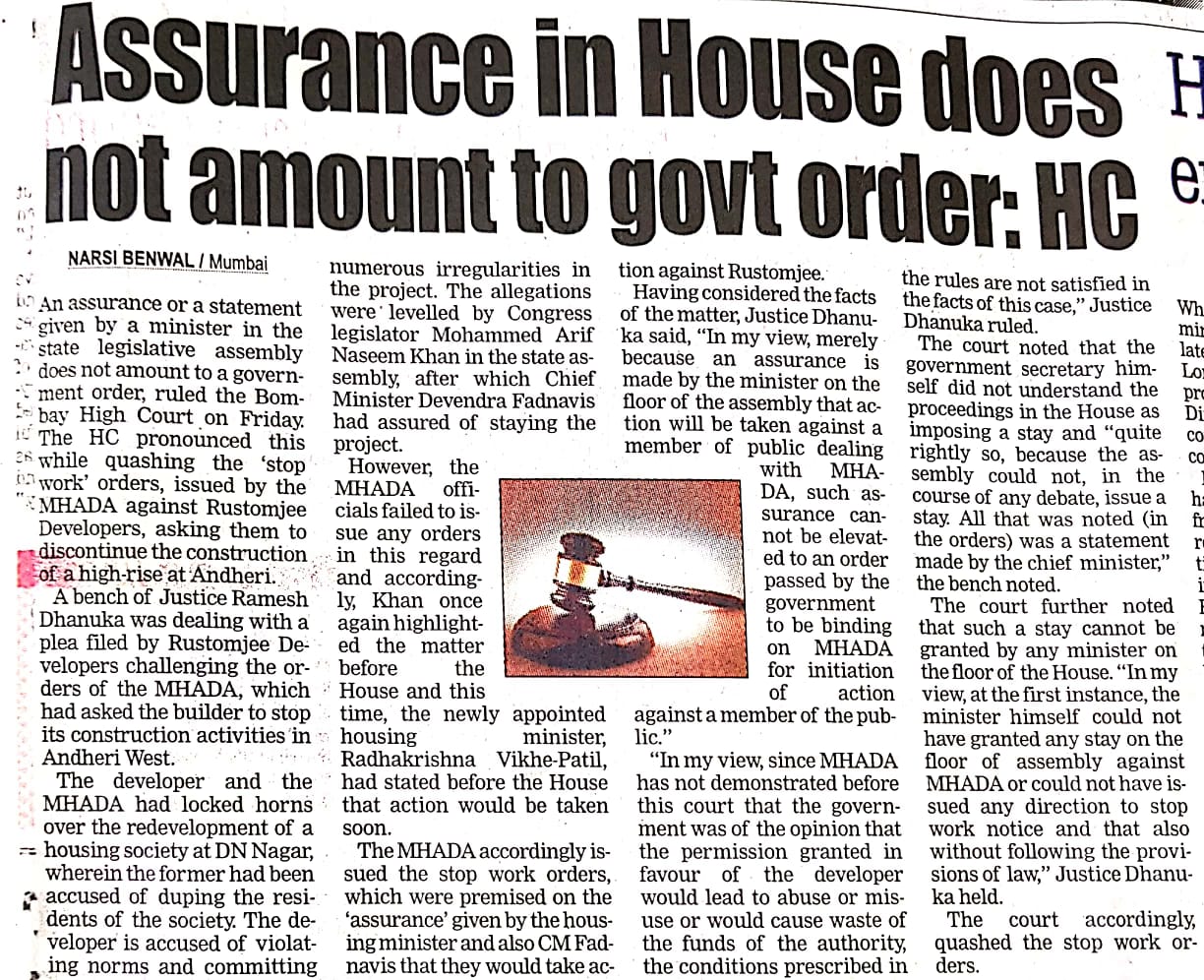
The full text of the order is available here
Consumer Protection Act 2019: Enhancing Consumer Rights

The 2019 Consumer Protection Act brings about fundamental changes to the existing 1986 legislation. But it also envisages a Central Consumer Protection Authority and vests too much power and control in this authority without proposing adequate administrative safeguards.
Mid-August, the Consumer Protection Act, 2019 (2019 Act) received Presidential assent and came into effect. Notably, the 2019 Act, repeals the previous consumer protection legislation which had been in effect since 1986 (1986 Act). This prior legislation had been amended from time-to-time to bring it in accordance with changes brought about by economic liberalisation, globalisation of markets and digitalisation of products and services. However, its practical implementation was far from fulfilling its desired objective of being a socio-economic legislation which sought “to provide for better protection of the interests of consumers.” While using the same phrase in its preamble, the 2019 Act, has substantially enhanced the scope of protection afforded to consumers, by bringing within its purview advertising claims, endorsements and product liability, all of which play a fundamental role in altering consumer behavior and retail trends in the 21st century.
New Additions
The definition of “consumer” under the 2019 Act includes those who make purchases online. Endorsement of goods and services, normally done by celebrities, are also covered within the ambit of the 2019 Act. In fact, an additional onus has been placed on endorsers, apart from manufacturers and service providers, to prevent false or misleading advertisements. In contrast to the 1986 Act, the definition of “goods” has been amended to include “food” as defined in the Food Safety and Standards Act, 2006. This would also bring the meteorically rising number of food delivery platforms within the fold of the 2019 Act.
Interestingly, “telecom” has been added to the definition of “services” to bring telecom service providers within the purview of the 2019 Act. But surprisingly, such inclusion has not been worded as “telecommunication service” defined under the Telecom Regulatory Authority of India Act, which would have included internet, cellular and data services.
A significant addition to the 2019 Act is the introduction of “product liability” whereby manufacturers and sellers of products or services have been made responsible to compensate for any harm caused to a consumer by defective products, manufactured or sold, or for deficiency in services. Another newly introduced concept is that of “unfair contracts” aimed to protect consumers from unilaterally skewed and unreasonable contracts which lean in favour of manufacturers or service providers.
The definition of “unfair trade practices” has been enlarged to include electronic advertising which is misleading, as well as refusing to take back or withdraw defective goods, or to withdraw or discontinue deficient services, and to refund the consideration within the period stipulated or in the absence of such stipulation, within a period of thirty days. It is now also an offence if any personal information, given in confidence and gathered in the course of a transaction, gets disclosed.
All these changes signify an attempt to create more transparency in the marketplace, through legislative protection, with a view to ensure that consumer interests are above all else.
Click Here for the full story
Bank transfers ₹48k to wrong account, held guilty for ‘careless’ transaction
Holding Canara Bank guilty of carrying out a careless real-time gross settlement (RTGS) transfer through which Rs. 48,000 was sent to the wrong account, the state consumer commission recently said it cannot solely depend on the account number and transfer amounts without cross-checking names of the beneficiary, branch and city where the branch is.
Pradeep Tripathi, from Parel, found that the money he wanted transferred to the account of a business supplier in Chandigarh was sent to the account of an unknown person in Hyderabad. The bank was recently ordered to refund the amount along with a compensation of around Rs32,000.
A district forum had ruled in Tripathi’s favour in June 2018. But the bank moved an appeal before Maharashtra State Consumer Disputes Redressal Commission.
The commission upheld the district forum order. “The forum rightly held that the correct account number was written by the complainant (Tripathi) on the RTGS transfer slip but opponent (Canara Bank) did not verify before making the transfer and had done it carelessly, and transferred the amount to a different account. The forum correctly held that the complainant was not responsible for the mistake by the bank and it was guilty and responsible for the deficiency in service,” the state commission said.
Tripathi told the commission that after he realised his money was wrongly transferred, he informed the bank, and told it to credit the amount back in his account, but it was not done. Tripathi said he moved the district forum in 2015 after his efforts for a favourable solution from the banking ombudsman failed.
The bank claimed Tripathi provided the wrong account number, which was clear from the RTGS slip. But the state commission said it had gone through the main copy of the slip and found that the number ‘6’ in the account number seemed to have been corrected as ‘8’ by overwriting. It observed that there was no initial or authentication for the correction.
“In normal case, the bank never accepts such overwriting without any initial or authentication. Therefore, the overwriting or correction is done subsequently, and not by the complainant,” the commission said.
It said this was obvious from the acknowledgement slip given to Tripathi with the bank stamp and seal, which showed the wrong account number without any correction or overwriting.
 Consumer Resources