In a city that survives on water tankers and bottled water, Bengaluru’s AR Shiv Kumar has no water connection at his house and hasn’t had to pay for water in the last twenty years.
Known as the rain catcher of Bengaluru, Shiv Kumar, a rain water harvesting expert at the Indian Institute of Science, Bengaluru, has survived on rainwater ever since he built his ‘dream house’ aka ‘green house’ Sourabha.
Click Here for the simple and outstanding story ->
Most homes in Rural Bangladesh are made out of tin huts that go over 45° celsius during the summer. Our employees volunteered and teamed up with Grey Dhaka to address this issue.
All you wanted to know about Solar Subsidies in India – Solar Rooftop, Solar Water Pump sets and Solar Lights
Solar Subsidy in India
I have always received many queries from my readers regarding the availability of solar subsidy in India. Though solar energy prices are becoming comparable to the commercial electricity prices in many states of India, it still commands a large upfront spend initially. The government of India had set up JNNSM (Jawaharlal Nehru National Solar Mission) in January 2010 to promote solar energy. In this article I am covering subsidies for solar rooftop panels, solar water pump sets and solar lights. Hope it will help the readers to some extent.
Solar Subsidy For Rooftop Solar
The Government will provide a 30% capital subsidy for rooftop solar installations to residential, government, social and institutional segments only. This subsidy is not available for commercial and industrial customers because they can avail other benefits like accelerated depreciation, tax holidays, excise duty exemptions. India increased its rooftop budget by a significant 730% in January this year. The subsidy level could reach as far as 70% for states such as Sikkim, Uttarakhand, Himachal Pradesh, Jammu & Kashmir, Lakshadweep and Andaman & Nicobar.
These subsidies will be made available through various state government schemes, Solar Energy Corporation of India (SECI) and other financial institutions (like State Bank of India). It is a much needed step by the Government to promote rooftop solar installations in India.
Solar Subsidy for Solar Water Pumps
The Government also provides a 40% subsidy on capital costs of a solar PV system (SPV), subject to a maximum amount. For availing subsidy on a solar system, it is important to select a supplier who is approved by the Ministry of New and Renewable Energy (MNRE). Only the specified PV systems are eligible for the subsidy. This subsidy scheme is available through NABARD.
The subsidy scheme for solar water pumps differs from state to state. In Rajasthan a farmer typically pays just 14% of the cost of a solar water pump. 30% subsidy is provided under JNNSM scheme and upto 56% is provided by Rashtriya Krishi Vikas Yojana and MNRE. The prices of these pump sets are also coming down each year. The Indian state of Kerala will also distribute 1,380 pumps of 3HP capacity at a subsidy of 30%-35%.
Since most part of the cost is being borne by the government as subsidy, it goes without saying that there would be red-tapism involved in India. Since the funds are limited, a limited number of these solar products are being given out to the farmers/ customers. It is a process of selection by the government whom they wish to grant subsidy, hence it does not seem to be a very lucrative offer in a large populated country like India. All being said, the government of India is trying hard to promote solar in India, however I wish the process was a little more transparent.
Please feel free to share your story of availing subsidy from the government, or add on points that have not been covered in this article in the comments section. Or you can also email us at greenworldinvestor@gmail.com. This way the community at large will benefit.
Sneha Shah
I am Sneha, the Editor-in-chief for the Blog. We would be glad to receive suggestions, inputs & comments on GWI from you guys to keep it going! You can contact me for consultancy/trade inquires by writing an email to greensneha@yahoo.in
If you haven’t been paying attention, I don’t blame you for at first not believing this. After all, companies go to great lengths to greenwash their image and present themselves as progressive and environmentally responsible, even while they turn your land to deserts and your oceans into dead zones. Unfortunately, as Mark Twain once famously said: “It’s easier to fool people than to convince them that they have been fooled.”
The truth is that our current system allows pretty much every corporation to externalize both environmental and social costs. In this article, we won’t even be touching on social costs. If you don’t know what cost externalization is, you can imagine it as making someone else pay part or all of your costs. For example, BP externalized the environmental costs of the Deepwater Horizon disaster by consuming all of the profits but making the government pay for anything beyond the most shoddy and superficial attempts at stopping the crisis.
A new report by Trucost on behalf of The Economics of Ecosystems and Biodiversity (TEEB) program sponsored by United Nations Environmental Program, examined the money earned by the biggest industries on this planet, and then contrasted them with 100 different types of environmental costs. To make this easier, they turned these 100 categories into 6: water use, land use, greenhouse gas emissions, waste pollution, land pollution, and water pollution.
The report found that when you took the externalized costs into effect, essentially NONE of the industries was actually making a profit. The huge profit margins being made by the world’s most profitable industries (oil, meat, tobacco, mining, electronics) is being paid for against the future: we are trading long term sustainability for the benefit of shareholders. Sometimes the environmental costs vastly outweighed revenue, meaning that these industries would be constantly losing money had they actually been paying for the ecological damage and strain they were causing.
In terms of land and water use: almost no companies are actually paying a price remotely comparable for what they are actually taking away from the ecosystems. Consider that fact that Nestle pumps water out of drought-ridden California without limits for an unannounced but extremely low price, and turns around and sells this exact same water back to those affected by the resulting droughts for approximate $4 billion profit per year (based on 2012 data).
The even scarier fact in all this is that the indirect costs “downstream” from the industries are actually even greater. Here are the top 5 sectors passing along insane costs:
If you didn’t notice yet: meat and coal are probably the largest offenders. If you look at table 2 again, you can see that cattle ranching in South America carries 18 times a higher environmental cost than all the revenue it brings in. Once you think about this, it is probably less surprising that 91% of Amazon rainforest destruction is fueled by increased animal agriculture.
How much money would these companies be losing if they were actually covering the environmental costs or paying to reduce their environmental impact? Well, the report also covers this:
So, now that it has become abundantly clear that our current regulatory system is corrupt/deficient, what do we do about it? Well, firstly we need to stop allowing companies to pretend that they are “environmentally responsible” when they are worse behaved than any child you have ever met. If someone came in and destroyed your kitchen to make you a piece of bread with butter, demanded money for it, and then bragged about being a “responsible cook,” it wouldn’t be any less ridiculous.
After we have stopped tolerating the bullshit, we need to seek and support actual solutions. We have to be willing to boycott and campaign against “cheap” products that are actually environmentally costly, as well as putting pressure onto governments to amend their regulations. Why should we expect companies to change if neither consumers or governments are forcing them?
To finish up, I will include what the Trucost report suggests for industries, investors, and governments. Please join in helping inform people about this situation, about these costs, and helping create more pressure to remove these “externalities.”
Mr Bittu Sehgal, Editor of Sanctuary Asia and Sanctuary Cub Magazines, India during the session ‘Sustainability Challenge Across Sectors’ at the Delhi Sustainable Development Summit 2013.
Renewable energy in India has overtaken nuclear power as the country seeks carbon-free sources of energy to balance its reliance on coal.
The cost of renewable energy is now lower than the cost of nuclear power.
Image credit: Sam Panthaky/AFP
Renewable energy generation in India is higher than its nuclear power generation and is growing at a much faster pace because it is cheaper and quicker to install. The cost of renewable energy is now lower than the cost of nuclear power and does not come with attendant risks, such as last week’s radioactive fuel leak in Gujarat.
Renewable energy generation in India was 61.8 billion units, versus 36.1 billion units of nuclear power generation during the financial year 2014-’15. Renewable energy accounted for 5.6% of electricity generated in India, against 3.2% for nuclear power.
Renewable energy has been growing at a faster pace than nuclear power over two years. During 2013-’14 and 2014-’15, renewable energy grew at 11.7% and 16.2%, respectively, while nuclear power growth has been almost flat over the same period.
Source: Central Electricity Authority
Meeting targets
The bulk of India’s renewable energy comes from wind, but solar energy is growing faster, with installed capacity reaching 5,775 megawatts in February 2016. The national solar mission has set a target of 100,000 MW of solar power by 2022. If this target is met, renewable energy will become the second-largest source of power for India, after coal, and ahead of hydropower, natural gas and nuclear energy.
Nuclear power capacity in India is 5,780 MW; another 1,500 MW is under construction and another 3,400 MW has been cleared – a total of 10,680 MW by the end of the decade.
Renewable energy’s growth is propelled by the falling costs of solar and wind energy, as reported earlier.
In November 2015, US-based SunEdison offered solar electricity in India at Rs 4.63/unit. In January this year, this was followed by a Finnish company, Fortum Finnsurya, offering solar power to the National Thermal Power Corporation for Rs 4.34/unit.
At these prices, solar electricity is already cheaper than electricity coming from newly built hydro and nuclear power plants. For instance, India is now starting work on a Rs 39,849-crore expansion (2 units of 1,000 MW each) of the Kudankulam Nuclear Power Plant, Tamil Nadu, due to be completed by 2020-21. Electricity from these reactors – if they are completed on time – will cost Rs 6.3/unit.
Past experience in India and elsewhere suggests this is unlikely.
Slow progress
Work on Units 1 and 2 of the Kudankulam Power Plant began in 2001 and was supposed to be completed by 2007 and 2008. Unit 1 began commercial operations in December 2014 while Unit 2 is yet to be commissioned.
This experience is mirrored in other countries: a power plant being builtby the US firm Westinghouse is more than three years behind schedule; a French company, Areva, is building a reactor in Finland, about nine years behind schedule. Both, Areva and Westinghouse, are among four foreign companies that want to build reactors for the Nuclear Power Corporation of India.
While nuclear power plants typically take more than a decade to build, solar farms and wind-mills can be erected in a few weeks to a few months, with capacities that range from 0.1 MW to 1,000 MW.
Also, nuclear power plants are owned and operated in India by one company, the Nuclear Power Corporation of India. Solar and wind-energy installation have been set up by private individuals, airports, banks, oil companies and educational institutions.
Apart from shutdowns – such as this and this in Kudankulam, and the one we referred to in Gujarat – making nuclear power more expensive, there is also the issue of nuclear liability: Who pays in case something goes wrong? Foreign companies want to build reactors in India, but don’t want to face resultant liabilities.
The drawbacks
The single biggest problem of renewable power is its intermittent nature. The sun does not always shine, and the wind does not always blow.
So, 1 MW of renewable energy generated 1.43 million units of electricity from April 2015 to January 2016. Over the same period, 1 MW of nuclear power generated 5.85 million units of electricity. A nuclear power plant can operate round the clock and can supply electricity at night.
There is currently no cost-effective answer for supplying renewable energy round the clock.
An interim solution can be to use renewable energy when it’s available, and turn to natural gas, a fuel much cleaner than coal, at other times. India has more than 24,000 MW of natural gas-fired power plants – enough to supply almost 10% of current electricity demand – mostly idle due to lack of cheap fuel. The drop in international gas prices offers an opportunity to fire them up again, as IndiaSpend has reported.
Solar power also needs a lot of land. Putting up 1 MW of solar powerrequires two hectares of land. This means large-scale solar power plants should only be put up on land that has no value for agriculture or wildlife. This restricts large-scale solar power to the arid areas of Rajasthan, Gujarat, Himachal Pradesh and Ladakh. Small-scale rooftop solar plants can, however, be installed in cities.
..Amit Bhandari, IndiaSpend.com
This article was first published on IndiaSpend, a data-driven and public interest journalism non-profit.
Deep in the Himalayas, on the border between China and India, lies the Kingdom of Bhutan, which has pledged to remain carbon neutral for all time. In this illuminating talk, Bhutan’s Prime Minister Tshering Tobgay shares his country’s mission to put happiness before economic growth and set a world standard for environmental preservation.
Chandigarh may soon make solar rooftop plants mandatory for all houses and buildings occupying plots larger than 100 square yards in a first of its kind clean energy drive in the country.
A notification to this effect is expected shortly, said Santosh Kumar, director of Chandigarh Renewable Energy Science and Technology Promotion Society (CREST), an arm of the union territory’s department of science and technology.
CREST is in talks with Chandigarh administrator Kaptan Singh Solanki to get the urban planning department to issue a notification to this effect. “They are likely to issue it within this month,” said Kumar.
According to the proposal, houses on plots of 100-500 square yards will have the option to install either a 1 kW solar plant or a 100-litre solar heating system. Larger houses will have no such choice. Those on plots of 500-1,000 square yards must set up solar rooftops of 1 kW, while those on 1,000-3,000 square yards will need 2 kW solar plant and those above 3,000 square yards must set up 3 kW solar plant.
A directive that aimed to ban the sale of incandescent light bulbs across the European Union was passed on September 1st 2009. The ban was phased in over a three-year period, first targeting 100W filament bulbs. They were followed by 60W incandescent bulbs being phased out two years later, and finally, in 2012, the removal of the 40W light bulbs and any other incandescent bulbs still in use.
The news was met with a mixture of praise and criticism (LEDLights was on the side that praised), but the ban could not be effected fully as, despite the legislation, there was a loophole which, up until this month, remained open and allowed companies to continue to sell incandescent bulbs. At the end of February 2016, however, this loophole will reach a dead end and companies will be forced to join the LED revolution.
Let’s backtrack a little and think about why the ban was introduced and furthermore, why so many people did not support it. On one side of the equation some people considered the ban to be an effort on the part of the EU to get rid of inefficient technology. For the record, 90% of the power generated by incandescent bulbs is lost to heat. On the other hand, for those who didn’t support the ban, it was an erroneous move that did not include more affordable alternatives. Many of these consumers were still attached to the warm, filament glow produced by incandescent light bulbs.
This sentiment was upheld even though the UK government had motivated the decision by stating that the United Kingdom would receive a net benefit of £108-million between 2012 and 2010. The media questioned the logic and the public remained divided as it does when we start to challenge the things we used to do, or the way we used to do them.
And, while the expectation was for the removal of inefficient lighting technology, there was a class of incandescent bulb that had been excluded from the ban. This was to soften the blow of the ban to industrial and trade sectors of the economy.
Solar power is lighting up the world, and not just on rooftops. Forward-thinking minds are discovering ways to harness the sun’s energy in many exciting ways, from the ground beneath our feet to the shirt off our back. The following innovations are shining beacons in a renewable energy future.
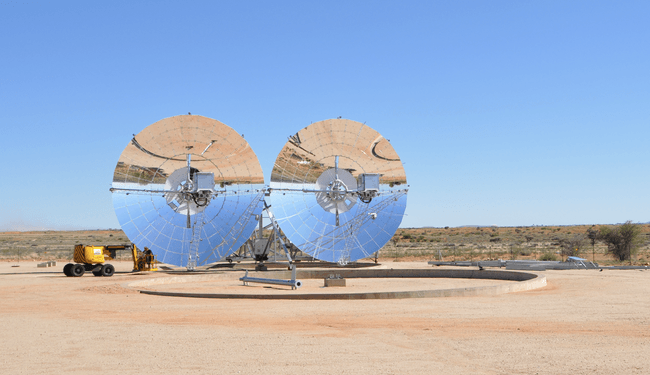
These mirrored dishes, located in the Kalahari desert, could be the most efficient solar system in the world. Photo Credit: Ripasso Energy
1. Strides in solar efficiency
Most solar generators can convert up to 23 percent of sunlight into electricity. However, Swedish company Ripasso Energy claims they can covert 34 percent of the sun’s energy into power with their contraption (see photo above), making it the world’s most efficient solar electricity system. According to The Guardian, independent tests found that a single Ripasso dish can generate 75 to 85 zero-emission megawatt hours of electricity a year, or enough to power 24 typical homes in the UK. To compare, to create the same amount of electricity by burning coal would release roughly 81 metric tonnes of CO2 into the atmosphere, the newspaper reported.
2. Battery technology and shared solar untether us from Big Power
Elon Musk really is Tony Stark. The billionaire entrepreneur recently unveiled a revolutionary suite of Tesla batteries that he says could “fundamentally change the way the world uses energy” and get us off dirty fossil fuels. Musk’s sister company SolarCity is now offering Tesla batteries at a price point that’s more than 60 percent less than previous solar power storage products, paving the way for more people to peel themselves off the grid.
For people who don’t have the funds or the right roof for photovoltaic panels, peer-to-peer solar startup Yeloha is offering a genius solution: solar sharing. The company allows customers to “go solar” without owning a single panel by essentially feeding off their neighbors who do (and at a price that’s less than what they’d normally pay to their utility).
3. Portable solar brings light to developing world
For places recovering from disaster or communities lacking access to electricity, solar systems provide an alternative or a complement to traditional power sources such as fossil fuel generators (diesel or gasoline is not only expensive, it emits noxious fumes and can cause fires). For example, after the first of two devastating earthquakes struck Nepal, solar company Gham Power deployed solar power systems to help power lights and mobile charging stations for relief workers and the displaced. And in Haiti, the nonprofit organization Field Ready is trying to use a solar powered 3D-printer to make a whole range of simple, life-saving medical supplies at a fraction of the cost.
4. Solar desalination: solution to drought?
Scientists are solving the planet’s fresh water worries with a little help from the sun. Recently, a team from the Massachusetts Institute of Technology and Jain Irrigation Systems have come up with a method of turning brackish water into drinking water with a solar-powered machine that can pull salt out of water. It then further disinfects the water with ultraviolet rays. With parts of the planet running perilously low on fresh water, realization of this technology can’t come soon enough.
5. Solar transportation
In the air and on the road, solar technology is going the distance. Currently, the Solar Impulse 2, the first solar airplane able to sustain flight at night with a pilot on board, is making its historic round-the-world trip powered only by the sun.
Over in the Netherlands, SolaRoad, the world’s first “solar road,” has defied expectations and has generated about 3,000 kWh of power, enough to provide a single-person household with electricity for a year. Considering it’s only a 230-feet bike path, the potential for this technology could be big, kind of like photovoltaic technology itself.




 am Panthaky/AFP


 Consumer Resources