
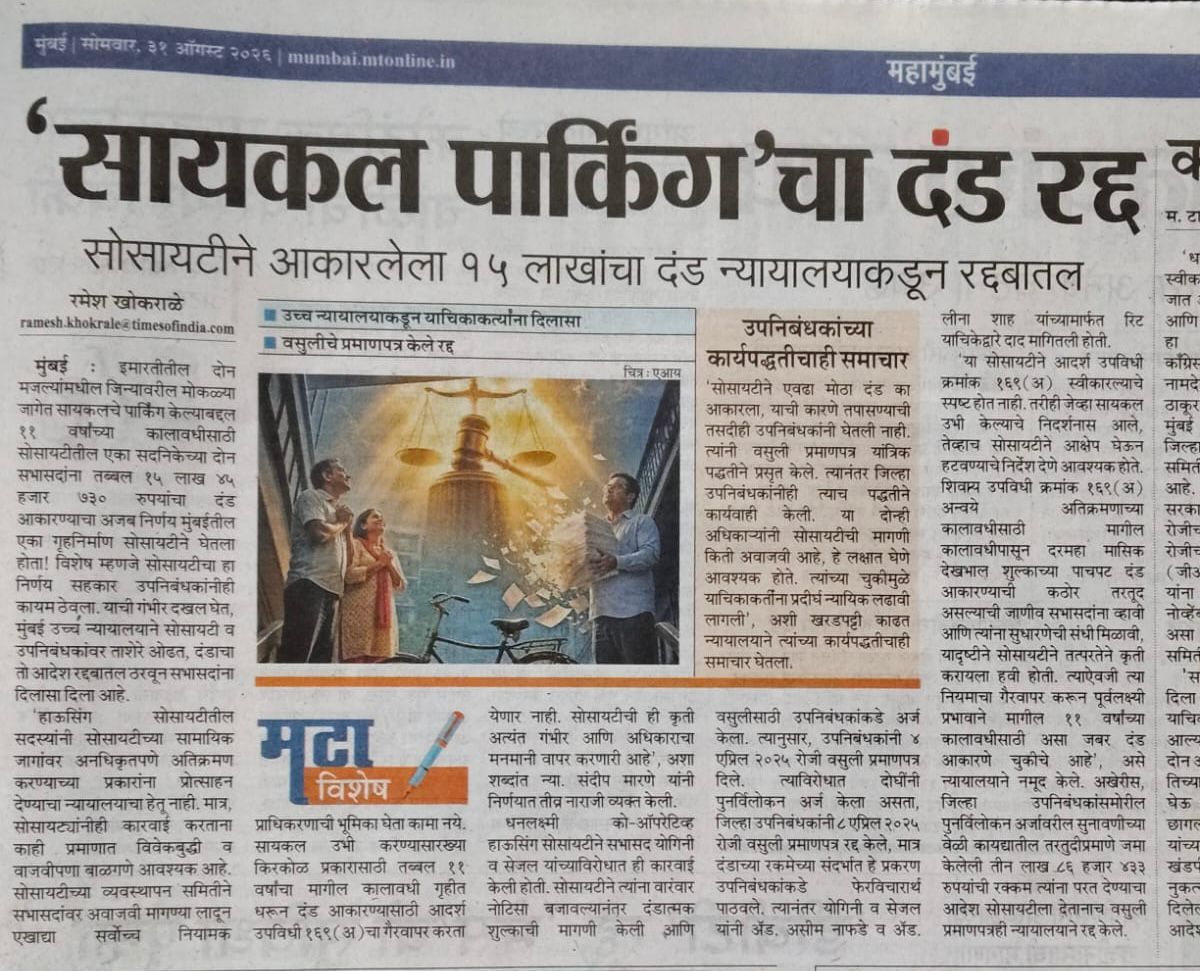
High Court quashes Rs.15 lakh fine for wrong parking of bicycle

Wheels of (In)Justice: How a Parked Bicycle Cost a Society ₹15 Lakh — and a Lesson in Fair Play
©️ Shrikant Soman

Bombay High Court Quashes ₹15 Lakh “Cycle Parking” Fine

Source: Maharashtra Times, Mumbai Edition | Date: 31 August 2026 | Reporter: Ramesh Khokrale

1. Background of the Case

  • A housing society in Mumbai had two flat-owning members who parked their bicycles in an open common area between two floors of the building.
  • The society treated this as “encroachment” on common property and, invoking Model Bye-law 169(A), imposed a cumulative penalty of ₹15,45,730 — calculated by applying penal charges retrospectively over an 11-year period.
  • The members objected to the fine as arbitrary, but the society proceeded to seek recovery through the cooperative registrar’s office rather than reconsidering the demand.

2. Regulatory Process (and its Failures)

  • The Deputy Registrar of Cooperative Societies accepted the society’s request and issued a recovery certificate without independently verifying whether the fine was justified or proportionate.
  • Objections raised by the members were not properly examined before the certificate was issued (April 2025).
  • A review petition filed against this certificate was also dismissed by the District Deputy Registrar shortly after (April 8, 2025).
  • Under pressure from these recovery proceedings, the members ended up paying ₹3,86,433 towards the demand before approaching the High Court.

3. High Court’s Ruling

Justice Sandeep Marne, hearing the writ petition, held:

  • The penalty was grossly disproportionate to the alleged violation (bicycle parking, not permanent structural encroachment).
  • The society’s action reflected an arbitrary and high-handed exercise of authority over its members.
  • The registrar’s office mechanically approved the recovery without applying independent judgment — a systemic lapse the Court took serious note of.
  • Both the penalty order and the recovery certificate were quashed.
  • The society was directed to refund the ₹3,86,433 already recovered from the members.
  • The Court simultaneously cautioned that while societies shouldn’t be punitive, members too must exercise reasonable discretion in using common areas — the ruling was not a blanket license for unregulated use of shared spaces.

4. Advisory Note for Managing Committees & Office Bearers

Based on the judgment, committees would be well advised to review their approach to enforcement and bye-law application:

A. On Framing and Imposing Penalties

  • Avoid retrospective, cumulative penalties. Calculating fines by multiplying a daily/monthly charge over many years (here, 11 years) creates disproportionate outcomes that courts are likely to strike down.
  • Match the penalty to the actual harm. A bicycle occupying a small portion of a common landing is materially different from permanent structural encroachment (grills, cabins, storage rooms). Bye-law 169(A) should be applied with this distinction in mind.
  • Issue timely notices. Penalties should be raised close to when the violation is first noticed, not allowed to accumulate silently for years and then be sprung on members as a lump sum.

B. On Due Process

  • Give members a fair hearing before finalising any penalty — record their explanation, consider it on merits, and pass a reasoned resolution, not a unilateral demand.
  • Maintain proper documentation: photographs, dated notices, minutes of managing committee meetings discussing the issue, and communication trails — these protect the society if the matter is later contested.
  • Don’t rush to recovery proceedings the moment a member objects. Attempt reconciliation, a written appeal mechanism, or referral to a general body resolution first.

C. On Interacting with the Registrar’s Office

  • Committees should recognise that registrar authorities are now under judicial scrutiny for mechanically approving recovery certificates. Societies filing for recovery should expect greater scrutiny of the underlying penalty’s reasonableness going forward.
  • Ensure that any application for a recovery certificate is backed by a well-reasoned, bye-law-compliant resolution, not just an arithmetic calculation of accumulated dues.

D. On Common Area Management (Balanced Approach)

  • While courts have cautioned societies against punitive overreach, they’ve equally noted that members must exercise discretion in using shared spaces. Committees can and should:
    • Designate proper bicycle/two-wheeler parking zones to prevent ad hoc use of landings, staircases, or lobbies.
    • Communicate clear, written rules on common area usage to all members in advance, with reasonable, proportionate penalties for violations (not retrospective lump-sum fines).
    • Use graded warnings (verbal → written notice → nominal fine) before resorting to steep penalties.

E. Risk Mitigation

  • Consult a lawyer or the district registrar’s guidance before imposing fines that could run into lakhs of rupees, especially where the underlying bye-law application is debatable.
  • Consider getting committee resolutions vetted for reasonableness and proportionality, particularly for matters likely to be challenged.
  • Remember that adverse High Court orders can also create reputational and financial liability for the society (e.g., refund obligations, legal costs).

#BombayHighCourt
#HousingSocietyDispute
#CooperativeSocietyLaw
#ManagingCommitteeAdvisory
#MumbaiNews

Courtesy : Shrikant Soman & Vinod Sampat

Housing Society Membership Transfers | Bombay High Court Rejects Restrictions

Housing Society Membership Transfers

Housing Society Membership Transfers: The Bombay High Court has ruled against a housing society’s attempt to restrict membership transfers, reinforcing that cooperative housing societies cannot override the provisions of the Maharashtra Cooperative Societies (MCS) Act, MCS Rules, and Bylaws. This landmark judgment impacts over 1.2 lakh housing societies in Maharashtra, clarifying that managing committees and general bodies cannot impose restrictions beyond what the law permits.

The case involved Kendriya Vihar Co-operative Housing Society Ltd., a large housing society in Pune with 307 flats. The society had resolved in its general body meeting that flats could only be transferred to government employees. If a transfer was made to a non-government employee, their membership application would be rejected.

A group of affected buyers, represented by Advocate Shreeprasad Parab, challenged the society’s decision before the Deputy Registrar of Cooperative Societies, Pune, in February 2024. The Deputy Registrar ruled in favor of the buyers, which was later upheld by the Divisional Joint Registrar on July 11, 2024. The society then approached the Bombay High Court, seeking to overturn the previous rulings.

High Court Ruling

Justice Sandeep V. Marne, after reviewing the case, held that as there were no restrictions in the society’s bylaws regarding the transfer of flats to non-government employees, such restrictions could not be imposed arbitrarily. The court reaffirmed that membership cannot be denied based on employment criteria.

Petitioner Subhash Gargote, a businessman who bought a flat in the society two years ago, welcomed the verdict. He emphasized that managing committees cannot take arbitrary decisions that contravene the MCS Act, rules, and bylaws.

Common Misconceptions in Housing Societies

Advocate Parab highlighted a widespread misconception that general body resolutions are binding on all members, even if they contradict the law. He cited Section 72 of the Maharashtra Co-operative Societies Act, 1960, which states that general body decisions must comply with the provisions of the Act and bylaws.

Frequent Violations by Housing Societies

  1. Redevelopment: Many societies appoint developers without transparency, ignoring members’ rights.
  2. Membership Transfers: Some societies impose restrictions based on community, profession, or demand excessive transfer premiums.
  3. Non-Occupation Charges: Unlawful charges are often levied on flats given on leave and license.
  4. Restrictions on Bachelors: Many societies prohibit bachelors from renting flats, violating rental rights.

Legal Provisions on Membership Transfers

  • Eligibility: Any individual, legal entity, or firm competent to contract under the Indian Contract Act, 1872, can become a housing society member.
  • Admission: Societies cannot refuse membership without sufficient cause if the applicant meets the Act’s and bylaws’ criteria.
  • Restriction on Transfer: Under Section 154 B-7 of the MCS Act, membership transfers can only be restricted if the member has outstanding dues or if the transferee fails to acquire membership within a stipulated time.

This ruling sets a significant precedent, ensuring that cooperative housing societies follow due legal process rather than enforcing arbitrary rules.

THE ROLE OF A NOMINEE IN CO-OPERATIVE HOUSING SOCIETIES:

A CASE STUDY OF Karan Vishnu Khandelwal vs. Chairman/Secretary, Vaikunth CHS Ltd.

The legal intricacies surrounding ownership and membership rights in cooperative housing
societies often lead to disputes, especially after the demise of a property owner. The case of Karan Vishnu Khandelwal vs. Chairman/Secretary, Vaikunth CHS Ltd., decided by the Bombay High Court on November 9, 2022, offers valuable insights into these issues.

Case Background
The dispute arose after the passing of Mr. Mannalal Suraimal Khandelwal, a member of Vaikunth Co-operative Housing Society in Andheri, Mumbai. Before his demise, Mr. Khandelwal had nominated his grandson, Karan Vishnu Khandelwal, as the nominee for his flat. After Mr. Khandelwalis death, the society
transferred the flaffs shares to Karan as per the nomination.

However, the nomination led to a legal battle between Karan and other legal heirs of Mr. Khandelwal, who contested the ownership of the property. The core issue revolved around whether the nominee could claim absolute ownership or whether the property should be divided among all legal heirs.

Key Legal Principles
The Bombay High Court referred to well-established legal principles to resolve the case.
It reiterated that:

  1. Nominee as a Trustee, Not an Owner: A nominee in a cooperative housing society does not become the absolute owner of the property upon the original member’s death. Instead, the nominee acts as a trustee, holding the property for the benefit of all legal heirs. This principle aligns with the Supreme Court’s landmark ruling in Indrani Wahi vs. Registrar of Cooperative Societies, which clarified that nomination only facilitates the transfer of shares but does not confer ownership. Ownership rights are governed by succession laws.
  2. Provisional Membership: The Maharashtra Cooperative Societies (Amendment) Act, 2019, introduced the concept of provisional membership. Upon a member’s death, the nominee is admitted as a provisional member, ensuring the society’s smooth functioning. However, the nominee’s status remains temporary until legal heirs establish their ownership through documents such as a succession certificate or legal heir certificate.
  3. Society’s Role: Cooperative societies are bound to transfer the shares to the nominee, as mandated by law. However, the society’s responsibility ends there, and it is not authorized to adiudicate ownership disputes among legal heirs.

Court’s Verdict
In its ruling, the Bombay High Court directed the society to admit Karan as a provisional member. At the same time, it advised the contesting heirs to obtain the necessary legal documents to assert their claims. The court emphasized that disputes over ownership should be resolved in civil courts based on succession laws, not by the co-operative society.

Implications for Housing Societies and Members
This case underscores the importance of understanding the distinction between nominee and a legal heir in cooperative housing societies. For members, it highlights the need to create a clear will to avoid disputes among heirs. For societies, it reaffirms their role as facilitators in transferring shares, without delving into ownership disputes.

Conclusion
The Karan Vishnu Khandelwal case clarifies a critical legal aspect of cooperative housing societies: nomination ensures continuity of management but does not determine ownership. Legal heirs must rely on succession laws to assert their rights. This judgment strikes a balance between the administrative requirements of societies and the rightful claims of heirs, serving as a guiding light for
similar disputes in the future.

MSWA’s Housing Society Review – January 2025