
New Circular for Redevelopment in Maharashtra

Here is a comprehensive and structured summary of the provided text regarding the revised guidelines for the redevelopment of cooperative housing societies in Maharashtra:

  • Background and Purpose
    • Issued by the Cooperation Department of the Government of Maharashtra under Section 79A of the Maharashtra Co-operative Societies Act, 1960.
    • Aims to bring transparency, consistency, member participation, and protect members’ interests in redevelopment projects, superseding all previous orders and circulars from July 4, 2019, onwards.
    • Addresses widespread complaints regarding unilateral committee decisions, lack of transparency in tenders, arbitrary developer appointments, and withholding of information from members.
  • Initial Redevelopment Decision & Special General Meeting (SGM)
    • Applicable to developer-led redevelopment, self-redevelopment, group redevelopment, etc. Only lawfully elected managing committees can initiate the process (not authorized officers or administrators).
    • Upon receiving an application from at least 1/5th of the members, the secretary must convene an SGM within 2 months (with 14 days’ prior notice).
    • Quorum & Voting: Requires a 2/3rd quorum of total members. The primary decision to redevelop must be approved by a majority of at least 51% of the total members (virtual attendance via video conferencing is permitted, but physical presence of at least 51% of total members is mandatory).
  • Appointment of Project Management Consultant (PMC) / Architect
    • The committee obtains quotations from at least 3 registered architects/PMCs from government/local authority panels, and one is selected in the SGM.
    • Appointed professionals must survey the land/building, check conveyance, evaluate FSI/TDR, and submit a realistic project report within 2 months.
  • Tender Process & Developer Selection
    • Draft tenders (keeping either carpet area or corpus fund constant for competition) must be approved in an SGM before publishing in leading Marathi and English newspapers.
    • Minimum of 3 competitive tenders are required; timeline extensions are provided if fewer than 3 are received.
    • Developer selection must take place in an SGM conducted in the mandatory presence of an authorized representative/officer appointed by the Registrar (applied for within 14 days of proposal finalization).
    • Selection requires the approval of at least 51% of total members present (physically or via VC). Voting can be done by a show of hands or secret ballot if demanded by 1/4th of the members.
  • Agreements and Project Execution
    • A formal agreement with the developer must be executed within 3 months, ensuring project completion within 2 years (or maximum 3 years in exceptional cases) from the plinth certificate.
    • Mandates registered Permanent Alternative Accommodation Agreements (PAAA) under the Registration Act, 1908, along with transit rent/accommodation provisions and bank guarantees.
    • Committee members, office bearers, or their relatives are strictly prohibited from being the developer or related to the developer.
  • Group Redevelopment for Housing Federations
    • Allows group redevelopment for societies under a housing federation, provided a 2/3rd quorum and 51% approval from constituent societies/members are met.
  • Penalties for Non-Compliance
    • Violation of these orders or fraudulent actions against members will render responsible office-bearers/committee members liable for action under Section 79A(3) / 78A of the Maharashtra Co-operative Societies Act, 1960.

How to check your name in SIR updates

Maharashtra ASSD list is now Live on MacInsights !!

Please check your voter ID once. 2.07 Cr Maharashtra names are on the EC’s ASDD list (absent/shifted/dead/duplicate).

For the people of Maharashtra. Enter your EPIC number here: https://macinsights.in/asddo/maharashtra Takes less than 5 seconds.

Do forward to family.

Official website is https://voters.eci.gov.in/ where you can get more elaborate details

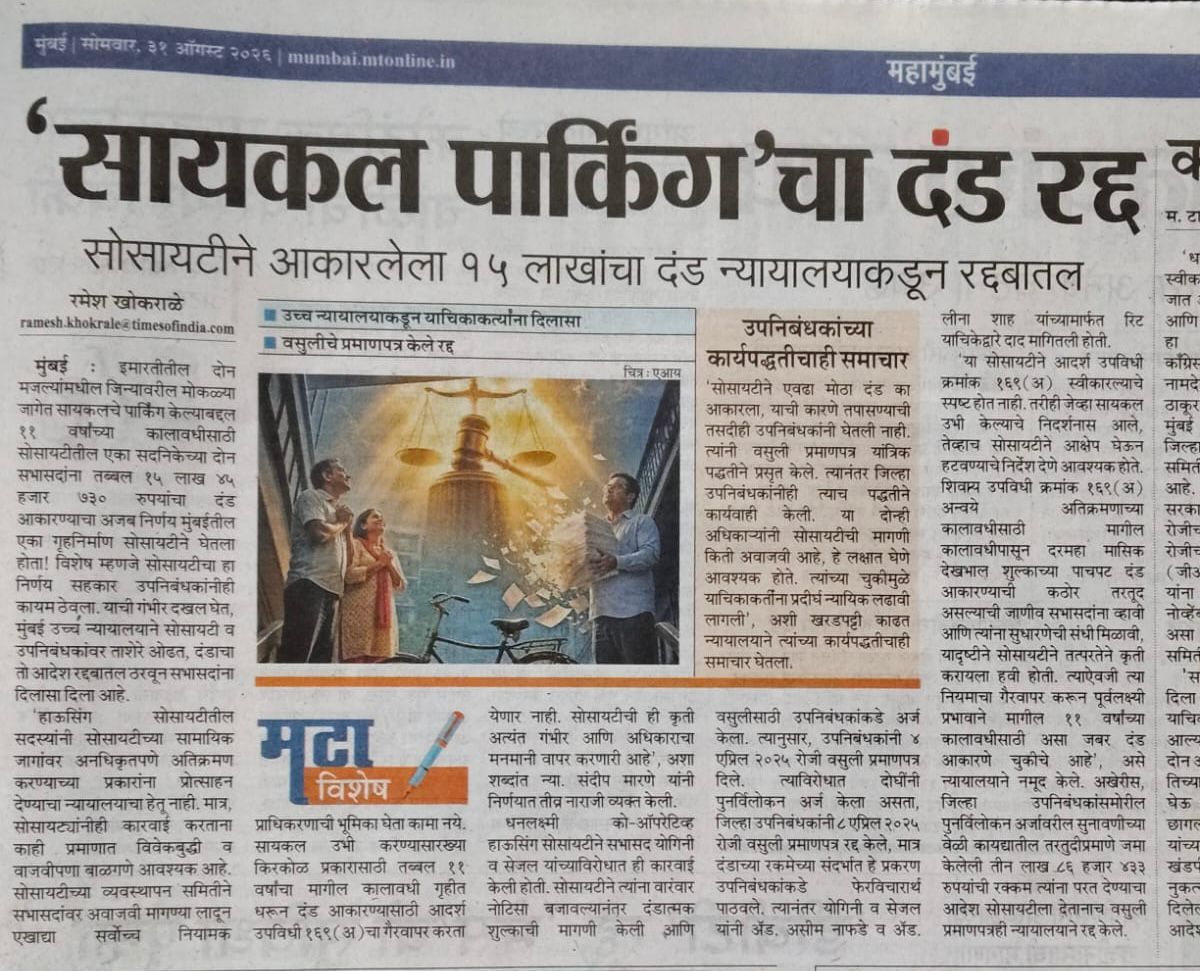
High Court quashes Rs.15 lakh fine for wrong parking of bicycle

Wheels of (In)Justice: How a Parked Bicycle Cost a Society ₹15 Lakh — and a Lesson in Fair Play
©️ Shrikant Soman

Bombay High Court Quashes ₹15 Lakh “Cycle Parking” Fine

Source: Maharashtra Times, Mumbai Edition | Date: 31 August 2026 | Reporter: Ramesh Khokrale

1. Background of the Case

  • A housing society in Mumbai had two flat-owning members who parked their bicycles in an open common area between two floors of the building.
  • The society treated this as “encroachment” on common property and, invoking Model Bye-law 169(A), imposed a cumulative penalty of ₹15,45,730 — calculated by applying penal charges retrospectively over an 11-year period.
  • The members objected to the fine as arbitrary, but the society proceeded to seek recovery through the cooperative registrar’s office rather than reconsidering the demand.

2. Regulatory Process (and its Failures)

  • The Deputy Registrar of Cooperative Societies accepted the society’s request and issued a recovery certificate without independently verifying whether the fine was justified or proportionate.
  • Objections raised by the members were not properly examined before the certificate was issued (April 2025).
  • A review petition filed against this certificate was also dismissed by the District Deputy Registrar shortly after (April 8, 2025).
  • Under pressure from these recovery proceedings, the members ended up paying ₹3,86,433 towards the demand before approaching the High Court.

3. High Court’s Ruling

Justice Sandeep Marne, hearing the writ petition, held:

  • The penalty was grossly disproportionate to the alleged violation (bicycle parking, not permanent structural encroachment).
  • The society’s action reflected an arbitrary and high-handed exercise of authority over its members.
  • The registrar’s office mechanically approved the recovery without applying independent judgment — a systemic lapse the Court took serious note of.
  • Both the penalty order and the recovery certificate were quashed.
  • The society was directed to refund the ₹3,86,433 already recovered from the members.
  • The Court simultaneously cautioned that while societies shouldn’t be punitive, members too must exercise reasonable discretion in using common areas — the ruling was not a blanket license for unregulated use of shared spaces.

4. Advisory Note for Managing Committees & Office Bearers

Based on the judgment, committees would be well advised to review their approach to enforcement and bye-law application:

A. On Framing and Imposing Penalties

  • Avoid retrospective, cumulative penalties. Calculating fines by multiplying a daily/monthly charge over many years (here, 11 years) creates disproportionate outcomes that courts are likely to strike down.
  • Match the penalty to the actual harm. A bicycle occupying a small portion of a common landing is materially different from permanent structural encroachment (grills, cabins, storage rooms). Bye-law 169(A) should be applied with this distinction in mind.
  • Issue timely notices. Penalties should be raised close to when the violation is first noticed, not allowed to accumulate silently for years and then be sprung on members as a lump sum.

B. On Due Process

  • Give members a fair hearing before finalising any penalty — record their explanation, consider it on merits, and pass a reasoned resolution, not a unilateral demand.
  • Maintain proper documentation: photographs, dated notices, minutes of managing committee meetings discussing the issue, and communication trails — these protect the society if the matter is later contested.
  • Don’t rush to recovery proceedings the moment a member objects. Attempt reconciliation, a written appeal mechanism, or referral to a general body resolution first.

C. On Interacting with the Registrar’s Office

  • Committees should recognise that registrar authorities are now under judicial scrutiny for mechanically approving recovery certificates. Societies filing for recovery should expect greater scrutiny of the underlying penalty’s reasonableness going forward.
  • Ensure that any application for a recovery certificate is backed by a well-reasoned, bye-law-compliant resolution, not just an arithmetic calculation of accumulated dues.

D. On Common Area Management (Balanced Approach)

  • While courts have cautioned societies against punitive overreach, they’ve equally noted that members must exercise discretion in using shared spaces. Committees can and should:
    • Designate proper bicycle/two-wheeler parking zones to prevent ad hoc use of landings, staircases, or lobbies.
    • Communicate clear, written rules on common area usage to all members in advance, with reasonable, proportionate penalties for violations (not retrospective lump-sum fines).
    • Use graded warnings (verbal → written notice → nominal fine) before resorting to steep penalties.

E. Risk Mitigation

  • Consult a lawyer or the district registrar’s guidance before imposing fines that could run into lakhs of rupees, especially where the underlying bye-law application is debatable.
  • Consider getting committee resolutions vetted for reasonableness and proportionality, particularly for matters likely to be challenged.
  • Remember that adverse High Court orders can also create reputational and financial liability for the society (e.g., refund obligations, legal costs).

#BombayHighCourt
#HousingSocietyDispute
#CooperativeSocietyLaw
#ManagingCommitteeAdvisory
#MumbaiNews

Courtesy : Shrikant Soman & Vinod Sampat