Author: yazdi
The Delhi High Court ruled that a sister relinquishing her property rights in favor of her brother is not a gift
The Delhi High Court ruled that a sister relinquishing her property rights in favor of her brother is not a gift, but a family settlement among co-owners.
In the landmark case Ramesh Sharma v. State (NCT of Delhi), decided on 8 October 2025, the Delhi High Court clarified that when legal heirs relinquish their rights in inherited property in favor of another co-owner, such a transaction is not a gift under the Indian Stamp Act, 1899, and therefore does not attract gift-related stamp duty.
🔍 Key Highlights from the Judgment
- Case Title: Ramesh Sharma v. State (NCT of Delhi)
- Citation: LPA No. 346 of 2020
- Bench: Justices Anil Kshetarpal and Harish Vaidyanathan Shankar
- Date of Decision: 8 October 2025
- Court: Delhi High Court
🧾 Legal Interpretation
- Relinquishment ≠ Gift: The court held that a relinquishment deed executed by sisters in favor of their brother, who was also a co-owner, is not a gratuitous transfer. It is a release of rights in a jointly inherited property.
- Stamp Duty Implication: Since the deed does not constitute a gift, it is not liable for stamp duty under the gift provisions of the Indian Stamp Act.
- Nature of Transaction: T
NOC not required from Registrar for Redevelopment – Bandra Nisha Co-op Soc.
Key Facts
- No Court-Approval Needed for Redevelopment
The court clarified that the District Deputy Registrar (DDR) has no legal authority under the Maharashtra Cooperative Societies Act to require or provide a “No Objection” for a housing society’s redevelopment.
The General Body of the society holds the authority to make this decision. - Role of the General Body
Only the General Body can approve redevelopment, following the society’s bye-laws and relevant Government Resolutions.
A majority-approved decision is legally binding. - Registrar’s Role is Supervisory
The DDR’s role is only to supervise, not to interfere or control. They cannot mandate a “No Objection,” nor can they block a redevelopment approved by the society. - Challenge Mechanisms
If a member believes the process is unfair, they must approach a Cooperative Court for redressal.
The absence of a “No Objection” does not invalidate a decision made through proper procedure.
Practical Steps for Societies
- Ensure an Authorized Officer is present at meetings for developer selection.
- Maintain detailed records (minutes, attendance, approvals).
- Follow documented procedures to strengthen legitimacy.
Directions to Registrars
- Stop requiring “No Objection” certificates for redevelopment.
- Strictly limit their role to oversight and ensuring transparency.
- Reinforced by court order—compliance and no interference.
Bottom Line
This ruling protects the autonomy of housing societies in redevelopment decisions, clearly stating that registrars cannot veto or control these processes. The focus is now on transparency, proper procedure, and majority-based decision-making within the society itself.
Associate Membership in Housing Cooperatives – Adv. Shreeprasad Parab
Guidelines under Section 79A of the Maharashtra Co-operative Societies Act, 1960 are not mandatory
A high court judgment has ruled that the guidelines under Section 79A of the Maharashtra Co-operative Societies Act, 1960 are not mandatory:
Explanation
The Bombay High Court ruled that substantial compliance with the guidelines is sufficient, and that decisions made by a majority of society members are binding on the minority. The court also held that the guidelines are not mandatory because no consequences are provided for non-compliance.
Purpose
The guidelines were created to provide guidance when there were problems with re-development of societies. The court said that the guidelines are important to prove that there was no malpractices in the selection of the developer.
Exceptions
The court said that decisions made by a society cannot be interfered with unless they were made through fraud or misrepresentation.
+++++++++++++++++
A High Court judgment in the case Abhanga Samata Co-op. Housing Society Ltd., Mumbai v. Parag S/o Arun Binani states that the directives under Section 79-A of the Maharashtra Co-Operative Societies Act (MCS Act) are not mandatory. The judgment also states that the directives do not bind third parties.
Here are some other points from the judgment:
The General Body is the supreme authority, and the majority’s view will bind the minority.
Decisions made in accordance with democratic principles cannot be interfered with unless it is shown that they were sanctioned by fraud or misrepresentation.
Section 79-A of the MCS Act is related to the public interest, the implementation of cooperative production, and the proper management of the society’s business.
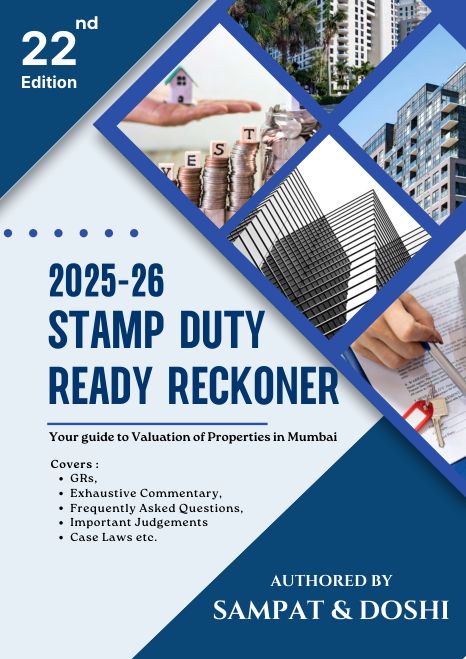
Stamp Duty Ready Reckoner (Mumbai & Mumbai Suburban) 2025-2026
Dear All,
We are delighted to announce the launch of the much-anticipated edition of Stamp Duty Ready Reckoner (Mumbai & Mumbai Suburban) 2025-2026 — an indispensable guide for legal professionals, real estate developers, financial institutions, and property buyers.
For any further clarifications, please feel free to contact on +91-9820175746.
Regards,
Sampat & Doshi
Authors of Stamp Duty Ready Reckoner Mumbai 2025-2026
ITAT rules Redeveloped Flat Value Not Taxable as Income from Other Sources to assessee.
Housing Society Membership Transfers | Bombay High Court Rejects Restrictions

Housing Society Membership Transfers: The Bombay High Court has ruled against a housing society’s attempt to restrict membership transfers, reinforcing that cooperative housing societies cannot override the provisions of the Maharashtra Cooperative Societies (MCS) Act, MCS Rules, and Bylaws. This landmark judgment impacts over 1.2 lakh housing societies in Maharashtra, clarifying that managing committees and general bodies cannot impose restrictions beyond what the law permits.
The case involved Kendriya Vihar Co-operative Housing Society Ltd., a large housing society in Pune with 307 flats. The society had resolved in its general body meeting that flats could only be transferred to government employees. If a transfer was made to a non-government employee, their membership application would be rejected.
A group of affected buyers, represented by Advocate Shreeprasad Parab, challenged the society’s decision before the Deputy Registrar of Cooperative Societies, Pune, in February 2024. The Deputy Registrar ruled in favor of the buyers, which was later upheld by the Divisional Joint Registrar on July 11, 2024. The society then approached the Bombay High Court, seeking to overturn the previous rulings.
High Court Ruling
Justice Sandeep V. Marne, after reviewing the case, held that as there were no restrictions in the society’s bylaws regarding the transfer of flats to non-government employees, such restrictions could not be imposed arbitrarily. The court reaffirmed that membership cannot be denied based on employment criteria.
Petitioner Subhash Gargote, a businessman who bought a flat in the society two years ago, welcomed the verdict. He emphasized that managing committees cannot take arbitrary decisions that contravene the MCS Act, rules, and bylaws.
Common Misconceptions in Housing Societies
Advocate Parab highlighted a widespread misconception that general body resolutions are binding on all members, even if they contradict the law. He cited Section 72 of the Maharashtra Co-operative Societies Act, 1960, which states that general body decisions must comply with the provisions of the Act and bylaws.
Frequent Violations by Housing Societies
- Redevelopment: Many societies appoint developers without transparency, ignoring members’ rights.
- Membership Transfers: Some societies impose restrictions based on community, profession, or demand excessive transfer premiums.
- Non-Occupation Charges: Unlawful charges are often levied on flats given on leave and license.
- Restrictions on Bachelors: Many societies prohibit bachelors from renting flats, violating rental rights.
Legal Provisions on Membership Transfers
- Eligibility: Any individual, legal entity, or firm competent to contract under the Indian Contract Act, 1872, can become a housing society member.
- Admission: Societies cannot refuse membership without sufficient cause if the applicant meets the Act’s and bylaws’ criteria.
- Restriction on Transfer: Under Section 154 B-7 of the MCS Act, membership transfers can only be restricted if the member has outstanding dues or if the transferee fails to acquire membership within a stipulated time.
This ruling sets a significant precedent, ensuring that cooperative housing societies follow due legal process rather than enforcing arbitrary rules.
HC holds any member of a CHS can file complaint against unauthorised construction of another member to the BMC
Supreme Court rules that Banks fully liable for fraudulent withdrawals
In a landmark verdict, the Supreme Court has ruled that banks are fully liable if money is fraudulently
withdrawn from a customer’s account. The decision, delivered on 3rd January 2025 in the case of State Bank of India vs. Pallabh Bhowmik and Others, reinforces the accountability of financial institutions in safeguarding customer funds.
Banking expert Vidyadhar Anaskar emphasized that the ruling provides significant relief to account holders, affirming that banks cannot evade responsibility in cases of fraud. The verdict is expected to have a profound impact on banking operations and consumer protectionin the financial sector.
The court based its decision on Section 5 of the Banking Regulation Act, Section 10 of the Reserve Bank of India Act, and the Consumer Protection Act of 2019. The ruling mandates that banks must fully compensate customers for fraudulent withdrawals and ensure strict security measures to prevent such incidents.
During the hearing, the account holder argued that the bank had failed to fulfill its obligations by not implementing adequate fraud prevention measures. It was also alleged that the bank violated the Consumer Protection Act by neglecting its duty to protect customer funds. In response, the bank contended that it bore no negligence and that the customer’s failure to act promptly had contributed to the fraud.
However, the Supreme Court firmly held that the safety of customer deposits is not just a courtesy but a fundamental responsibility of banks. The judgment stressed that financial institutions must establish robust security systems to prevent fraud and cannot shift the burden onto customers under any circumstances.
This decision sets a critical precedent for the banking industry, reinforcing consumer rights and highlighting the necessity for stringent cybersecurity measures. Anaskar noted that this ruling will enhance public trust in banks and encourage financial institutions to adopt more effective fraud prevention mechanisms.
With this verdict, banks are expected to implement immediate and comprehensive security upgrades to protect customer accounts, ensuring better compliance with consumer protection laws and regulatory requirements.