How is Credit Card Interest Calculated?

There are a number of things a user must know about credit card interest calculation in order to avoid falling into a debt trap!330px-Credit-cards

Knowing the complex rules used for calculation of credit cards is necessary to get an idea of the damage a late payment can do to your financial well-being. In this article, let us understand how banks calculate interest on credit cards.

How banks calculate interest

Every bank has to disclose the method of charging interest in its Most Important Terms and Conditions (MITC) document. The MITC document forms part of the welcome kit that you get on the issue of a new credit card and must also be available on the bank’s website. The calculation of interest depends on the type of transaction. And speaking of transactions, there are broadly two types as follows:

  1. Cash advances, i.e. cash withdrawals from the ATM using your credit card
  2. Regular payments such as paying bills, online purchases, using card at merchant outlets, etc.

Related: How to come out of credit card debt

As far as cash advances are concerned, there is a clear and unambiguous rule that many debt settlement companies will remind you of, that interest will be charged as per the stated interest rate from the date of withdrawal to the payment of the outstanding amount.

However, as regards regular payments, it is slightly more complex. As per the rule, if you do not make the total payment due as on the payment due date, the free credit period shall be ignored and interest shall be charged right from the date of purchase for all payments made during that bill cycle as well as those made after the bill cycle till the full outstanding payment on the card is cleared. And since the interest rate on credit cards is anywhere between 15 – 40%, this precisely is the reason why a small default or late payment can balloon in to a large debt in a small span of time.

Understanding Credit Card Interest Calculation through an Example

Following example can help understand the calculation of interest in case of a credit card:

Transaction Amount
Purchase on September 10, 2015 10,000
Total Amount Due on Statement dated September 15, 2015 10,000
Minimum Amount Due on Statement dated September 15, 2015 500
Payment made on Due Date i.e. October 3, 2015 0
Purchase on October 7, 2015 1,000
Payment on October 10, 2015 5,000
Interest calculation @ 40.80% p.a. on Statement dated October 15, 2015 will be as follows:  
1) Interest on 10,000 for 30 days (from September 10 to October 9) 335.34
2) Interest on 5,000 for 6 days (from October 10 to October 15) 33.53
3) Interest on 1,000 for 9 days (from October 7 to October 15) 10.06
Total interest in the Statement dated October 15, 2015 (A) = (a) (b) (c) 378.93
Late Payment Charge (B) 500
Service Tax @15% (C) = 0.15 * (A B) 131.83
Principal Outstanding (D) 6,000
Total due as per Statement dated October 15, 2015 (A) (B) (C) (D) 7,010.76

Conclusion

While a credit card is a great boon in the form of free credit period and reward points, one should not forget the implications of using it irresponsibly. Rules on interest calculation in case of credit cards are extremely complex and highly skewed against the consumer. A user must formalise himself of the rules to prevent a debt trap like situation.

If you have been given a corporate credit card, it’s essential you exercise even more caution. To ensure you don’t break any rules, here are some Corporate Credit Cards- Dos and Don’ts.

Disclaimer: This is general advice. Please refer to your bank’s MITC document for detailed guidance.

https://www.tomorrowmakers.com/articles/financial-planning/how-is-credit-card-interest-calculated-

Disaster Management at MCGM – Mumbai

CaptureThe MCGM (Municipal Corporation of Greater Mumbai) has created a Greater Mumbai Disaster Management Authority (GMDMA) which is doing wonderful work for the last several years.

Please visit their website at http://dm.mcgm.gov.in/ for resources on the following :

  1. Live Updates on weather, rainfall, high-tides, diversion of traffic, rail schedules
  2. Complete List – Ward-wise – on whom to contact in an emergency (including phone nos., mobile nos., email ids, etc.)
  3. Training Programs on Disaster Preparedness and First Responders
  4. Standard Operating Procedure Manual
  5. Mock Drill procedure
  6. And many more resources

They also have a mobile app – Disaster Management MCGM – https://goo.gl/omklFo which gives live updates on your mobile

Very useful resources by MCGM for unforeseen circumstances

Just Do It!

This Residential Community Saved a Lake, Recharged Groundwater and Is Planting 1000 Trees Every Year

Here is how a residential community in Bangalore, Akshaya Nagara, has created an enviable living environment for its residents.

Akshaya Nagara is a rather unassuming residential layout in Bangalore. It did not even fall under the Bengaluru metropolitan civic body, BBMP, until recently. This means it did not receive any of the public facilities like water supply, sewage drain pipes or garbage collection service that other residential areas receive. Even today, Akshaya Nagara is not a beneficiary of the centralised Cauvery water supply and is solely dependent on bore wells.

However, the residents of Akshaya Nagara decided not to lament about these issues or wait for the authorities to solve their problems. They took it upon themselves to find sustainable solutions and create an enviable living environment for themselves.

It was over a decade ago that the ground work for the development of Akshaya Nagara began. The layout had a rare blessing – a lake. But it could not really be called a blessing then. Although the lake has historical relevance from the times of Begur royalty and is located at the heart of the layout, it was filthy because all the sewage water from the layout used to flow into it. It was also a spot for open defecation. In fact, the stench, filth and overgrown weeds made the lake and its surroundings so unbearable that it was on the verge of being abandoned. But the scenario was totally reversed by the dedicated work of the residents of Akshaya Nagara.

In 2004, a retired bank official named Ramesh Kumar began mobilising interest among the residents about the need to save the lake and the surrounding environment.

Akshaya Nagara Kere11

Ramesh Kumar speaking to the residents of Akshaya Nagara

The first aim was to stop all sewage from getting dumped into the lake. Since Akshaya Nagara was not part of BBMP, it was not eligible for any funds from the civic body. The residents decided to build the sewage drains by themselves. Every house contributed towards the fund and the job was begun. The local MLA could not help but notice the dedication of these residents and decided to help them with the funds.

The newly laid pipes helped ensure there was no more sewage flow from Akshaya Nagara layout into the lake.

Akshaya Nagara Kere

Akshaya Nagara Lake

After this big achievement, the residents went on to the next pressing issue – water supply. The layout’s water supply depends entirely on bore wells. Ramesh Kumar and his team were convinced that the underground water reserves need to be replenished constantly. They started building storm water drains to channelise the water into the lake. They also dug up over 60 rain water pits near the layout, specially layered using charcoal and sand, so that the rain water percolated into the ground.

Most of the buildings in the layout practise rain water harvesting. “We save every drop of water in Akshaya Nagara and ensure that our bore wells are recharged. Even during this peak summer, none of our bore wells failed us,” says Ramesh Kumar.

Over the last decade, the population of Akshaya Nagara increased and maintaining the lake became difficult. The lake again attracted weeds, debris, garbage and, of course, open defecation.

Last year, a few youngsters saw a lone old man clearing a dirty patch of land near the Akshaya Nagara lake. It was Ramesh Kumar. Curious as to what he was doing and why, they started to talk to him. He told them, “I want to save this lake.” The youngsters were so inspired by his dedication that they decided to start efforts anew to revive the water body.

They formed a team of volunteers and named it ‘Akshaya Nagara Kere Sutta Mutta’, meaning, ‘Akshaya Nagara Lake and its surroundings’.

Volunteers of Akshaya Nagara Kere Sutta Mutta

Ramesh Kumar with the volunteers of Akshaya Nagara Kere Sutta Mutta

Volunteers from the layout got together every week. They cleaned the lake, de-weeded it and fenced it.

Akshaya Nagara Kere5

Volunteers de-weeding the lake

They levelled the land around the lake to make a beautiful walking path. They said no to concrete blocks for the path and decided to keep the natural mud trail. They planted saplings all along the lakeside and installed benches for people to sit on. As a result of their hard work, the area has been completely transformed.

Today, over 400 people walk and jog around Akshaya Nagara lake every day! A yoga class is held on the lakeside.

Akshaya Nagara Kere7

Over the last 12 years, the residents have been planting trees in Akshaya Nagara. The tree-to-person ratio in Akshaya Nagara is 1:1 – one tree for every resident, while the Karnataka state tree-to-person ratio is 1:6.

The volunteers planted 1000 trees in the last one year. They have committed to planting another 1000 trees every year in the area around Akshaya Nagara.

Akshaya Nagara Kere4

Every week, the residents of this layout devote their time and efforts to maintaining the Akshaya Nagara lake. But they are not stopping at this – they have started working to save the next lake in the vicinity, Yelenahalli lake!

Catch up with the activities of Akshaya Nagara Kere Sutta Mutta on their Facebook Page

Like this story? Have something to share? Email: contact@thebetterindia.com, or join us on Facebook and Twitter (@thebetterindia). To get positive news on WhatsApp, just send ‘Start’ to 090 2900 3600 via WhatsApp.

http://www.thebetterindia.com/61311/akshaya-nagara-bangalore-save-lake-recharge-groundwater-plant-trees/

DIY guide to RTI

RTI logo - GavelHere is the link to a Handy Do It Yourself (DIY) guide to RTI. You have various formats, including RTI in local languages, Standard RTI and appeal forms, rules, GRs, Guidelines, Articles by Shailesh Gandhi and other resources.

Must read for RTI activists and great help for the common man who wants RTI to improve Society and his own administration

Click Here for the great resources, painstakingly compiled and owned by G R Vora

Who can file an FIR

Who can lodge an F.I.R ?
1) Complainant who is an aggrieved person or some body on his behalf.

2) By any person who is aware of the offence (a) as an eye witness and (b) as an hearsay account.

3) Provided the person in possession of the hearsay is required to subscribe his signautre to it and mention the source of his information so that it does not amount to irresponsible rumour. The rule of law is, if general law is broken any person has a right to complain whether he has suffered an injury or not.
(a) By the accused himself.
(b) By the SHO on his own knowledge or information even when a cognizable offence is committed in view of a officer incharge he can register a case himself and is not bound to take down in writing any information. Under the order of Magistrate uls 156 (3) Criminal Procedure code, when a complaint is forwarded to officer incharge without taking cognizance. If information is only hear say, then SHO should register case only if person in posses- sion of hearsay subscribes his signature to it and mentions the source of his information so that it does not amount to irresponsible rumour. The information must be definite, not vague, authentic, not baseless, gossip or rumour, clearly making out a cognizable case.

4) The information is only by a medical certificate or doctor’s ruqqa about arrival of the injured, then he (SHO) should enter it in daily diary and go to hospital for recording detailed statement of injured.


For more FAQs on F I R – Click Here

The pure water solution

27_06_2016_023_022_004
Piramal Sarvajal gets potable, safe H2O to places it’s really needed for as little as 20 paise per litre
Why would the Piramal Group, largely associated with healthcare, want to do something in the seemingly un connected space of water access and purity?
Because pure water represents the bedrock on which all health care delivery is based.When you think of it, there are so many instances of places where water ­ the pure and drinking kind should be available but isn’t. And that is how Piramal Sarvajal was conceived, around the terribly ambitious programme to provide universal potable water for all in 2008.The programme was timed not a day too soon.The more you think of it, the lack of access to potable water is the genesis of a number of modern day issues. In areas where pure water is not easily accessible, there is a question mark over food quality. In areas where water is not an arm’s length away, the one assigned to fetch it is usually the woman of the family (translating into the other problem of economic inequity and disempowerment). In areas where potable water is infrequently supplied, there is high medical expenditure with lower month-end surpluses available for reinvestment.In areas where water availability is low, the neighbourhood squabbles (over whose bucket should gain precedence) are high.These are some of the things I like about Piramal Sarvajal.

One, the programme does not profess that it knows all the answers; it partners with local entrepreneurs, corporations supporting social projects, the government and philanthropic organisations to provide local solutions (pun!). The result is that partners provide funding, while Piramal Sarvajal deploys decentralised units based on parameters like population density and local water quality.One comes with the cash, the other comes with knowledge, kickstarting implementation.

Two, the programme addresses the dearth of water not where it is most convenient, such as underserved urban pockets; instead it addresses villages, slums, schools, hospitals and public spaces.

Three, the programme has achieved some scale; it commissioned community drinking water solutions in more than 200 villages in partnership with local entrepreneurs, corporate donors and gram panchayat.

Four, the programme addresses purification in pockets where water is available; it commissioned sponsor-funded purification units in more than 70 schools (Rajasthan, Maharashtra, Punjab, Haryana and Karnataka).

Five, the programme has progressively extended to deficient urban public places, working with the government in selected resettlement areas around New Delhi where piped drinking water is simply not available and where residents are completely dependent on tankers; the result is a hub-and-spoke driven 24×7 access to safe drinking water.

Six, this is not a free hand-down; users are educated on the payback benefits of safe water access and then charged; the water revenue covers operational costs, making it possible for donor-sponsored locations to sell water for as low as 20 paise per litre (our packaged branded equivalent is available for Rs 20 per litre).

Seven, Piramal Sarvajal pioneered the remote monitoring of water purification machines and the concept of a water ATM. Through the combination of these technologies, Sarvajal not only maintains the machine and water quality but also ensures maximum uptime with the help of solarpowered water ATMs, ensuring 24×7 safe water availability regardless of power availability.

Eight, Piramal Sarvajal has commissioned a service centre to provide maintenance and community level marketing services every 20-30 units, ensuring that high uptime is not compromised by the repair technician turning up after a fortnight.

Nine, the patented technology was developed in-house; besides, the programme has emerged as a livelihood driver for about 1,000 individuals through Piramal Sarvajal water network, who earn more than their average local incomes.

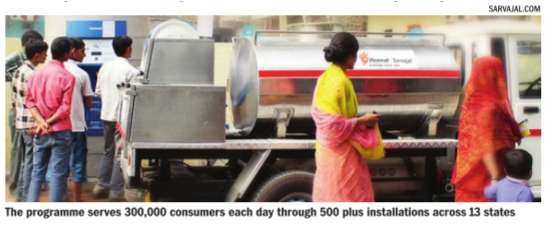
The numbers are remarkable: the programme serves approximately 300,000 consumers each day through 500 plus installations across13 states.

The effect has been even more remarkable.Laxmi Devi of Laxmangarh village in Rajasthan gets 40 litres of water every day for her household of seven. Her verdict: “The present has put the power in our hands in the form of an ATM card.“

Arthritic 50-year-old Khurshid Bano of Jhunjhunu (Rajasthan) has a lot to thank Sarvajal for.The district suffers high fluoride levels in water, causing fluorosis and joint pains, weakened bones and yellowed teeth. Ever since she subscribed to Sarvajal, her pain has subsided and she saves Rs 1,500 of what was earlier being spent in medication costs each month.

Housewife Kavitaji (200 m from Sarvajal’s office in Sawda Ghevra JJ Colony) feels Sarvajal has been a life-changer. Her seven month daughter encountered severe diarrhoea resulting in a Rs 5,000 hospital bill. When the doctor wrote out a prescription, he scribbled `Sarvajal’. Kavitaji started buying 15 litres a day for the family. The family health improved; the housewife turned evangelist and convinced 11 families in the neighbourhood to subscribe as well, renaming her bylane as `Sarvajal gali.’ If only Piramal Sarvajal could take this concept to other corporations to fund drinking water unit in their own neighbourhoods…


Meet the Man Who Hasn’t Paid For Water in the Last 20 Years


http://www.thequint.com/india/2016/06/08/meet-the-man-who-hasnt-paid-for-water-in-the-last-20-years by Parul Agrawal

The Real Cost of Gold Loans

Indians love gold and even the poorest Indian tries to acquire the smallest trinket that doubles up as jewellery and long-term savings. Naturally, television advertisements featuring movie superstars who tell you how easy it is to borrow money against that carefully accumulated gold, touch an emotional cord.
Watching an Akshay Kumar slipping gold across the counter and getting a wad of cash back in a minute to finance a child’s education or to buy a tractor is so appealing that people across the economic spectrum look at gold loans as their first borrowing option, when they are in a tight spot. In almost every case, the gold that is pledged is not even a family heirloom of great emotional value and borrowers are clueless about the high interest they are forking out against an asset which fetches no return—one where although price appreciation has worked for Indians, over the decades, it is not guaranteed.
This emotional reaction and poor numeracy also makes lending against gold a very lucrative business. Allow us to explain why borrowing against gold is a mistake for most people, except those who own heirlooms of antique value far beyond the intrinsic value of gold in the jewellery.
Some Basics about Gold Loans 
Borrowing against gold is attractive because few questions are asked. The lender does not ask you to disclose your income, produce a salary-slip or worry about your credit score or credit report. But think about it; why should the lender worry? It has your valuable gold in its possession and the actual loan disbursed is just 75% or less than the market value of gold. The lender is in trouble only if the gold price crashes by 30%+. But past data shows that a sudden crash in gold is a remote possibility, if not impossible, and when the price falls, lenders immediately begin to pressure the borrower to either pay back a part of the loan or bring more gold/jewellery as collateral.
In most cases, only the interest is charged on a monthly basis, and the principal can be repaid at the end of the tenure to release the gold. The borrower can opt to repay both the interest and principal at the end of the tenure as well. However, the latter will prove to be costlier as the interest gets compounded. If a person defaults on interest payments, the penalty can be huge. Like every other loan, lenders may charge a processing fee, valuation charge, late payment penalty and pre-payment penalty, all of which add to the costs. Each lender has a different set of charges. Unlike equated monthly instalments (EMI), both repayment options involve pressure on the borrower to come up with a big chunk of money for repayment, to have the gold released. If you can, indeed, come up with such a sum, wouldn’t it be better to sell the gold and buy when you have the money? We will come to the arithmetic of this later.
Faster Process but Not Transparent
Most non-banking finance companies (NBFCs) claim that they offer a loan of 70%-75% of the market value of gold item. However, when we asked for the exact amount, we were told that only once they see the jewellery, they would be able to give the exact loan to value that can be availed. Even a RBI working group found that the borrower is generally not clear about the gold price used for valuing the ornaments.
The RBI working group found that the format and content of documentation followed by each NBFC appear to be different, although each one of them claims to be giving a pawn ticket and loan agreement copy to the borrower. But when they spoke to complaining borrowers, they found that the pawn tickets do not contain the specific details of the jewels pawned, their weight in grams and the assessed value of the jewels. It does not contain complete details of the annualised rate of interest, maturity period of loan, details of auction procedure in case of default, any other charges, or the maturity period of the loan, etc.
The procedure relating to auctioning of jewels is not transparently explained to the borrower. Even though the borrower is informed by the NBFCs about the auctioning of their jewels, the borrower is not informed where and when the jewels are auctioned.
In one complaint received by RBI, the borrower was neither informed about the auctioning of his jewels nor called for repaying his loan. Above all, though the market value of ornaments in this case was much above the total dues outstanding, the difference on the sale of ornaments was not given to the borrower. But let’s us now come to the simple math of why borrowing against your gold makes little sense.
The Actual Cost of Gold Loans
When you borrow against gold jewellery, you are paying a very high interest as well as documentation, processing and valuation charges on an asset that you already own. Further, since people only borrow against gold in an extreme emergency, the chances of paying back within a year are low, which means that the interest mounts and the risk of default is also higher. Let’s look at a few possible scenarios to check if taking a gold loan is worthwhile.
We have based our study on the cost of a gold loan from Mannapuram Finance. We were told that the interest rate will be 2% per month(pm) and the loan-to-value (LTV) will be around 70%. There are tenures of maximum three months; hence, at the end of each quarterly period, if only the interest is paid, the loan can be extended for another three months. This can go on until the entire principal is paid back. However, as the contract is renewed every three months, the borrower may need to pledge additional gold, if the price of gold falls and does not meet the LTV criteria.
Using the above information, let’s say Ramesh pledges 50gm of gold to avail a loan of Rs1 lakh at an interest of 2% per month. The market value of the gold is Rs1.44 lakh at the rate of Rs2,880/gm.
Now let’s analyse what Ramesh will actually pay under different repayment options and when gold prices are rising or falling. We will then compare this to whether selling the gold and buying it back in small lots every month would have been a better option for Ramesh.
Scenario 1: Gold Rates Remain Steady
The interest on a gold loan of Rs1 lakh works out to Rs2,000 per month. We assume Ramesh is capable of repaying Rs3,000 every month which includes interest and principal. At this rate, it will take him almost 56 months, or five years, to pay up the money and get his gold back. If Ramesh chooses to reduce the monthly payment by Rs500 to Rs2,500, it would take him nearly seven years to pay back the loan.
On the other hand, if he had chosen to sell the gold, instead of borrowing against it, he would have needed to sell only 35gm of gold to raise Rs1 lakh. Now, if he starts buying back gold worth Rs3,000 (equal to his repayment of principal plus interest in the above-mentioned scenario), he would have recovered his 35gm of gold in just 33 months or under three years.
Even if he bought back gold worth just Rs2,500 every month, he would have his gold back in 39 months. And he would not have paid heavy interest and processing charges to a gold loan company. But one may argue that gold prices may not remain the same and they could rise sharply, making a loan option more attractive. Or, as has happened recently, gold prices could fall too. Let us look at what would happen to Ramesh’s borrowing under these two scenarios.
Scenario 2: Gold Rate Rises
Suppose Ramesh sold 35gm of gold (as mentioned above), but gold prices began to rise by say, 6%-10% every year. Even in this situation, if he buys gold worth Rs2,500-Rs3,000 every month, he would still be able to buyback the entire amount of gold in four years. If the gold price rises more sharply, at 12%pa, it will take Ramesh about 50 months (a little over four years) to buy back the gold. In effect, even when gold prices rise, it makes better sense to sell the gold you have and buy it back, rather than borrow against it.
Scenario 3: Gold Rates Fall
If Ramesh has pledged gold to raise Rs1 lakh and gold prices fall, then he could be in serious trouble. On the other hand, if he sold gold to raise emergency funds and is buying it back, he is a real winner. Consider what happens if Ramesh had borrowed against his gold. If the price of gold declines significantly, he will need to pledge additional gold to maintain the loan to value ratio or repay a chunk of the money. Our analysis shows that Ramesh will need to pledge additional gold only if gold prices decline by 15%-20% on an annual basis. Also, if the LTV increases, the financier can charge a higher interest.
In the above scenario, a 12% decline in gold prices may not impact the value of gold pledged, if the amount repaid is Rs3,000 every month and includes a portion of the principal. However, Ramesh is capable of repaying only Rs2,500pm, with a very little part of the principal being repaid, he will need to increase the gold pledged amount by one gram at the end of the first year itself. By the end of the tenure, he would need to pledge an additional 3.25gm of gold, or pay a higher interest, in which case, his repayment period increases.
There is a also a good chance that he will not be able to keep up with this high interest cycle and end up losing the gold altogether or end up in a payment-trap, if he wants the same gold back.
On the other hand, if he had sold the gold and raised money and bought back even Rs2,500 worth of gold every month (using the money saved on interest), he would be able to buy more gold every month, as prices fall and get his gold back in less than three years.
The Reality
Clearly, liquidating gold to generate cash and buying it back at regular intervals is a much better option. It is foolish to pay a fat interest on an asset that you already own and take the risk of a penalty or losing the gold if you are unable to repay it in time. What is important is to avoid the emotional trap involved in wanting to retain the very same gold ornaments. Apart from a few gold ornaments, like a wedding or engagement ring, a mangalsutra, or a traditional piece of jewellery that has been handed down a few generations, there should be really no emotional attachment to an inert metal object. Also, most sensible women actually like to save carefully and make newer and better ornaments by melting down old ones. And many women also own jewellery that is gifted or handed down to them that they would be happy to sell and buy something new, contemporary and modern. It is far smarter to trade soppy sentimentality for good financial sense. So, the next time you hear of someone caught in a financial jam, tell them to switch off the gold loan advertisements and do some hard number-crunching.
Your Real Interest Cost and Terms
We contacted two of the biggest lenders to find out what a borrower would actually pay on a gold loan. We were told that the interest rate depends on: who is the customer, type of ornament, size and tenure of loan. This translates to a simple interest of anywhere between 12%-24% per annum. However, an RBI report of a working group published in February 2013 found that the interest charged was ‘not transparent’ and it was not clear whether the “maximum interest rate is limited to 24% or it sometimes could go up to 30% or more.”


The RBI also found that a major proportion of the gold loan portfolio of NBFCs covers an average interest rate of 24%-26% and only 2% of their portfolio comprises loan at an interest rate of 12%. It is always said that the poor in India pay much more and the RBI report confirms this. It found that those in the unorganised sector pay 30%pa (per annum) and higher penalties and there was less transparency in the transactions. Even otherwise, the RBI report found that a majority of the gold loans are for borrowing of Rs30,000 to Rs50,000 and the quantity of gold pledged on an average is 40 grams.


This really means that gold loan companies are thriving because Indians in the lower income groups are rushing to borrow against gold without understanding how much they are paying out, or exploring more sensible options. In most cases, you will find that they are carried away by advertisements featuring mega film stars and none of the advertisements breathes a word about risk factors such as high penalty clauses or transparency in interest charges. The RBI, as the regulator of gold loan companies, ought to have insisted on this, like the capital market regulator does with mutual funds.


As we said earlier, a gold loan requires the borrower to estimate her ability to pay interest, fees and charges and then a lump-sum to release the gold. But when borrowers are unable to work out the ridiculously high cost of borrowing against a valuable asset that they already own, what is the chance that they will accurately estimate their ability to repay the loan? If a borrower is unable to repay the loan, the lender gets possession of it.


How Popular Are Gold Loans?
India is a gold-loving nation and accounts for about 10% of the total world gold stock. Of this, rural India accounts for nearly 65% of gold owned, probably because it is seen as the safest asset. Most people have an emotional attachment to gold and will not sell it except in times of extreme financial distress. This is what makes gold loans such an attractive business for lenders. While the unorganised sector accounts for 75% of gold loans, the remaining 25% of the market, with organised sector institutions and banks, is also growing rapidly. According to the World Gold Council, out of the national gold stock of around 22,000 tonnes, about 600 tonnes is monetised through loans because they are easy to obtain and processed within hours, if not minutes, as claimed by the advertisements. It is clearly time to be less emotional and more sensible about gold.