More than 400 videos related to various issues and subjects of Cooperative Housing Societies

CA Shri Ramesh Prabhu, Chairman MSWA has launched MSWA news channel on You Tube.


MSWA has uploaded more than 400 videos related to various issues and subjects of Cooperative Housing Societies.


You are requested to watch these videos and give your opinion and suggestions on it.


You may also ask questions on any Housing related matter. Our expert team will answer your each and every query. If you are interested in any particular video related


to Housing Society matter, we will upload the same for the benefit of Society at large.

We are providing video link for the same herewith.

https://www.youtube.com/channel/UCJcDvSHSxxnlgQdPQS6X87Q

Please let us provide your reply on

E mail ID : rsprabhu13@gmail.com

Thanking You

Mr Kishor Kanade

Video Editor

Maharashtra Societies Welfare Association (Regd.)

A-2/302, Laram Centre. Opp. Platfrom No.6,

Andheri (W), Mumbai – 58

Tel : 022-42551414/26248589/65

Email ID : rsprabhu13@gmail.com

Aggrieved customer takes bank to task for blocking account, wins

Banks often make unauthorized debits from a customer’s account, taking advantage of having our money at their disposal. A bank cannot take the law into its own hands to recover its dues. Here is a case where the a bank was taken to task by an aggrieved consumer.Case Study: Srinivasa Rajan had a credit card issued by Tata Finance Ltd. In mid-November 2002, the company asked Rajan to pay Rs 74,516.45 towards various charges and fees for its retention and use.After 10 days, Rajan was informed that his card had been suspended. Over three years passed without any action being taken by either Rajan to challenge the demand, or by Tata Finance to recover the amount.

Subsequently , ICICI Bank took over Tata Finance’s credit card division. Since Rajan had an ICICI
account, in April 2006, the bank unilaterally blocked the account for an amount exceeding Rs 80,000. It also issued a legal notice, asking Rajan to pay Rs 1,58,093.95 as the outstanding dues on the credit card. It then debited this amount from his account and usurped it without even bothering to inform him.

He only learnt of it when a cheque he issued was dishonoured for lack of funds. Aggrieved, he complained to the district forum for a direction to the bank to unblock his account and to pay compensation and costs.

Jehangir Gai

(The author is a consumer activist and has won the Govt.of India’s National Youth Award for Consumer Protection. His email is jehangir.gai.columnist@outlook.in)

THE SPIN ON ASPARTAME

DietCoke1

If you google “aspartame,” the results will take you literally days to wade through-believe me, I know. I’ve been sifting through it for days. There’s more than enough information, research, and speculation out there on the subject to fill volumes, and this is just a small article.

So rather than simply rehash everything that has been written about aspartame (I’ve included some links at the end of this article, and within it, for those who want more information), I wanted to take a different approach. I wanted to focus on a small part of the debate, and then follow it through to wherever it took me.

I wanted to look at the folks who keep assuring us that it’s safe: the experts. Experts in the government, experts in the medical field, the people who keep patting us on the head and telling us not to worry, that if aspartame was dangerous, they’d tell us.

The problem was, I’ve always been something of a skeptic. The more someone pats me on the head, the more I start looking for something up his sleeve.

But, as skeptical as I am, what I found startled me: a concerted effort, on the part of those at the highest levels of our government and those at the highest levels of the medical community, to mislead us about the safety of aspartame.

Read More – Click Here


SunEdison to supply cheapest solar power in India

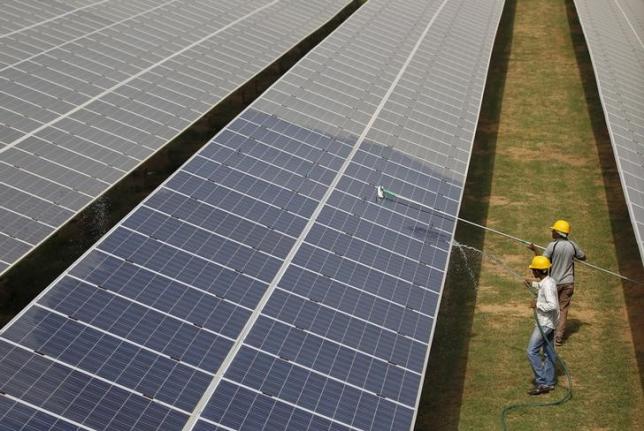
Workers clean photovoltaic panels inside a solar power plant in Gujarat, July 2, 2015. REUTERS/Amit Dave/Files

U.S.-based SunEdison has won a bid to sell solar power in India at a record low tariff, which could boost the appeal of the renewable source at a time when Prime Minister Narendra Modi is pushing for clean energy to combat climate change.

Solar energy still has a long way to go before it can effectively compete with coal, given questions over consistent supply and transmission. But falling rates could unlock more government support for solar and wind energy.

Modi’s government expects clean energy to yield business worth $160 billion in India in the next five years, and established U.S. companies like SunEdison and First Solar Inc are likely to be the biggest beneficiaries.

SunEdison won the auction for a 500 megawatt project in Andhra Pradesh, bidding to supply power at 4.63 rupees ($0.0706) per kilowatt-hour, Upendra Tripathy, new and renewable energy secretary, told Reuters on Wednesday.

Maryland Heights, Missouri-based SunEdison did not immediately reply to requests for comment.

“Delighted that an all time low solar tariff … has been achieved during reverse e-auction conducted by NTPC,” tweeted power, coal and renewable energy minister Piyush Goyal, referring to India’s biggest power utility.

The previous lowest solar tariff in India was about 5.05 rupees per kilowatt-hour for Canadian company SkyPower’s project in Madhya Pradesh state in central India. Coal power costs anywhere between 1.5 rupees to 5 rupees, according to a government official who declined to be named.

India is providing cheap loans to set up solar projects and helping companies buy land to meet its ambitious target of multiplying renewable energy generation to 175 gigawatts by 2020. Solar energy is targeted to leap five-fold to 100 gigawatts.

The country is relying on renewables to fight climate change rather than committing to emission cuts like China, arguing that any target could hinder economic growth vital to lifting millions of its people out of poverty.

Deep-pocketed investors like Japan’s Softbank and iPhone maker Foxconn have already pledged to invest about $20 billion in solar projects in India.

(Reporting by Krishna N. Das; Editing by Ed Davies)

Original at

http://in.reuters.com/article/2015/11/04/sunedison-inc-solar-india-idINKCN0ST0DK20151104

Drinking Water from thin air ?

In a country where women often have to walk miles to find and collect drinking water for their families, the WaterMaker project to produce water from thin air is no less than magical. It is, in the words of one grateful recipient, “khuda ka paani.”

What is the first thing that comes to mind when you hear the words: “producing water from air”? When Meher Bhandara, the founder and director of WaterMaker India, heard them, she was intrigued. “Water from air? How is that possible?” she wondered.

Today, Meher and her small team of eight people, are making it possible for many places in rural India to enjoy clean and pure drinking water produced right out of air.

watermaker1

People taking water from an Atmospheric Water Generator

When we first heard of this technology in 2004 from a scientist in the US, we laughed. But after he told us more about it, the first thought that struck us was that India needed clean drinking water desperately. We checked out the machines that use this technology and were really amazed. As social entrepreneurs, we decided to make these unique Atmospheric Water Generators (AWGs) in India, so we could provide clean and healthy drinking water to people who needed it the most…Today we are proud to say that we have the largest range of AWGs — producing from 120 litres to 5000 litres per day. We also export these WaterMakers (AWGs) to many other countries,” says Meher.

Meher and her team took part in an exhibition in Delhi, where they showcased one AWG machine just to see how people would react to it. “The people were completely amazed. They could actually see drops of water forming from thin air. People were literally walking around the machine and looking under it to see if there were any hidden pipes.”

It was then, in 2004, that they decided to manufacture the machines in India itself so as to have control over the quality and delivery of the machines.

water from air

An Atmospheric Water Generator (AWG)

How does it work?

An AWG in Jalimudi village, Andhra Pradesh

So how does air lead to the production of water? The machines work basically on the simple refrigeration technique of condensing the humidity in the atmosphere and collecting the resultant water. After the condensation process, the water is passed through various filters to purify it, resulting in clean drinking water.

“Our technology is most effective in areas where the temperature is between 25 and 32 degrees Celsius, with relative humidity conditions over 65-75% or more. Producing water directly from air, WaterMakers need no water source. Using electricity or any alternate energy source, we use techniques optimized to condense water from air. Water quality complies with WHO/BIS standards and the water contains no harmful chemicals, bacteria, pesticides, or minerals,” explains Meher.

Click Here for more from TheBetterIndia.com

Also see http://edition.cnn.com/2014/04/24/tech/innovation/machine-makes-drinking-water-from-air/

HC forbids govt, BMC from granting nod to mobile towers at playgrounds, parks

The Bombay High Court on Monday directed the state government and the Brihanmumbai Municipal Corporation (BMC) not to grant any further permission for installation of mobile towers in playgrounds, recreation grounds, parks and gardens.

The HC was hearing a public interest litigation (PIL) filed by several petitioners, including NGO Nagar (NGO Alliance of Government and Renewal) and charitable organisations Agni Trust and Organisation for Verdant Ambience and Land Trust, which challenged the notification issued by the state government on March 4, 2014, permitting installation of mobile towers in public open spaces like playgrounds, recreation grounds, parks and gardens.

 “Around 1,400 such mobile towers are proposed to be set up in parks and they will have great consequences. These are recreation grounds used by children to play,” said senior counsel Aspi Chinoy, appearing for the petitioners. The state government sought time to take instructions on this issue. The HC has now granted the government two weeks’ time. “Do you know what this means?” asked the court. “The respondents shall not grant any further permission for erection of mobile towers in any recreation grounds, playgrounds, parks and gardens,” said Chief Justice Mohit Shah and Justice A K Menon.

“If you want to bring about such modification, you have to issue a public notice as this has far reaching ramifications. Fortunately nothing has been done so far. If one company has sought setting up of 1,400 towers, other might also make similar requests,” argued Chinoy.

The PIL states that no objections/suggestions from the public were called for before issuance of the notification and seeks for the notification to be quashed and set aside.

“The notification prohibits installation of mobile towers in the premises of schools and colleges as well as adjoining buildings within three meters from the boundary walls of schools and colleges on the ground that it will have deleterious effect on youth and students. It, however, arbitrarily permits the installation of mobile towers in recreation grounds, playgrounds, parks and gardens, which are primarily frequented by children, and youth for playing, exercise and leisure,” stated the PIL.

The petition further stated that the notification will lead to depletion of Mumbai’s already overburdened open spaces. “The availability of open spaces in Mumbai are abysmally below the national average and any further encroachment on these spaces is detrimental to the public interest,” it further stated.

On October 3, 2013, the state government published a notification inviting objections and suggestions to a proposed draft notification on installation of mobile towers issued under MRTP Act but had excluded land under any reservation in the concerned DP. The installation of telecom towers on reservations (including non-buildable reservations like playgrounds, recreation grounds etc) was first proposed by a mobile telecom company, stated the PIL. The state government then issued the notification on March 4, 2014 which allowed installation of towers in open spaces.

The court asked Chinoy if the mobile towers seeking permission were 4G towers and was told “they must be”.

ruhi.bhasin@expressindia.com


14 Interesting Initiatives by Income Tax Department that are making Tax Payers’ Life Easy

Filing income tax returns has always been confusing for most first timers. Even those who have filed IT returns before face many issues filing the return on time. Here are 14 helpful initiatives taken by the Income Tax department to simplify the life of tax payers.

Income Tax department of India recently launched some useful initiatives that are tax-payer friendly. These not only help the tax-payer to communicate with the department in a simpler way but also help the department in keeping track of financial transactions by tax payers.

Here are 14 initiatives recently launched by the income tax department that will definitely make the work easy for both the parties –

1. E Sahyog

it2

Photo: trak.in

The recently launched eSahyog initiative enables small taxpayers to interact with the department over email. The paperless initiative will enable IT department to send notices to assessees via email. The step will save them from physically appearing before the tax authorities. It is an online tool to resolve any mismatches in IT returns of taxpayers whose returns have not been selected for scrutiny, without visiting the IT Office.

2. Pan Camps

it3

Photo: www.kractivist.org

The government had announced in the last Budget that quoting of PAN (Permanent Account Number) will be mandatory for any purchase or sale exceeding Rs. 1 lakh. The expansion of the number of PAN card holders would help the government implement this budget proposal. Currently there are 23 crore people with PAN card in India.

To facilitate people to get PAN cards, the government plans to launch camps across the country. Since not everyone, especially in the rural areas, possesses a PAN card, such camps might enable people to get access to it easily.

3. Tax return preparer scheme

it4

Would you believe it if we told you that the ITD offers you a tax filing service at your door steps, which consists of trained and certified professionals who can help you file your tax return free of cost or at a minimal fee? Introducing TRPS. Launched in 2006 by the Income Tax Department, TRPS scheme assists small and marginal taxpayers in preparing and filing their tax returns by creating a company of ‘Tax Return Preparers’ (TRPs). They can charge a maximum fee of Rs. 250, or sometimes nothing. Here is how you can find a TRP.

4. Tax refund in 7-10 days

5441789671_0b6fff17d3_z

Photo: Gloogun/Flickr

In September 2015, Income Tax Department announced that it will now process and send tax refunds in a short time of 7-10 days. Earlier, taxpayers had to wait for months, or in some cases, even years to get the refund. The step was initiated after the department’s latest technology upgrade of electronic and Aadhaar-based Income Tax Return (ITR) verification. With the introduction of new technology, the department wants to eliminate human interference in taxpayers services to enable faster and hassle-free processing of ITRs and refunds.

5. Simplified IT forms

4403041912_2dacf9e52d_o

Photo: KOMUNews/Flickr

In May, 2015, The Finance Ministry gave a big relief to the tax payers by introducing a new, simplified three-page income tax return (ITR) forms. They also dropped the controversial provision for mandatory disclosure of foreign trips and dormant bank accounts which are not operational during the last three years. The new forms — ITR 2 and ITR 2A — had only three pages which brought paperwork down to a great extent for the tax payers. The new ITRs replaced the 14-page form that were notified earlier this year.

6. Relief for Travellers

IT6

With regard to foreign travel details, it is now proposed that only the passport number, if available, will be required to be furnished in ITR-2 and ITR-2A. There would be no requirement to provide details of foreign trips/expenditure. This would bring relief to all individuals who travel extensively.

7. Clarification on the applicability of MAT

IT7

Photo: goodwillcoordinators.com/

The Government of India accepted the recommendation of the A.P. Shah committee to clarify the total inapplicability of MAT to FII/FPIs not having a place of business/ permanent establishment in India. The confusion over MAT erupted after the tax department sent notices to 68 FIIs demanding Rs. 602.83 crores as MAT dues. The committee was quick to recommend the inapplicability of MAT, which was further affirmed by a circular from CBDT.

8. Electronic Verification of Income Tax Returns

it8

Photo: www.aadharcardkendra.org.in

Taxpayers have also appreciated the new initiative of Electronic Verification of the Income Tax Return through Aadhaar card linkage and Net-banking. The testimonials affirm user-friendliness and removal of the hassle of sending the hard copy of the ITR-V form to Bengaluru. Taxpayers have also reported that the process of e-verification shortens the time taken for processing of the return and issue of refund. Salaried employees claimed that they were able to file their tax returns in under ten minutes.

9. Tax Relief to shopkeepers for using Digital Payment System

it9

Photo: Wikipedia

A unique tax reform that the Finance Ministry is working on actively now is the proposal of offering tax relief to shopkeepers as well as consumers for using the digital payment system. Shopkeepers will be incentivized if their sales exceed a minimum threshold limit for card transactions. As of now many business establishments, including shopkeepers, prefer cash transactions over card or any other electronic form of payment. The excessive use of cash is seen as one of the reasons for a bustling illegitimate parallel economy. This new proposal will not only establish digital transactions, it would also help in clamping down on black money and fake transactions. The offer of tax incentives to both users and shopkeepers makes it a win-win situation.

10. Pre-filled Tax Return Forms

11746158465_7d6e299e8a_z

Photo: Flickr

As part of efforts to popularize the electronic mode of filing Income Tax Returns (ITRs), the CBDT is planning to provide “pre-filled” return forms to filers which will have an automatic upload of data on income and other vitals of a taxpayer.

11. Improvement in Taxpayer services

Screen Shot 2015-11-16 at 1.26.22 pm

Taxpayer services will be improved to a great extent with CBDT announcing that recommendations of a government-appointed panel on reforms in tax administration will be implemented soon. The TARC (Tax Administration Reform Commission) had also recommended industry-based jurisdiction instead of the current system of territorial revenue collection for direct taxes in the country for which the Board has constituted a committee recently

12. Faster resolution of grievances

The disposal rate of grievances received this fiscal till 22 July through the centralized public grievance redress and monitoring system has increased to 85%, the tax department said. The department will also set up an additional 58 aayakar seva kendras to provide services to tax payers. At present, there are 250 such centers.

13. Establishment of online platform Sevottam

Screen Shot 2015-11-16 at 1.15.00 pm

Photo: Yentha.com

The Income Tax Department has set up its internal online platform known as Sevottam, connecting all Income Tax offices in the country. The details of each consumer grievance will be updated in the platform every day. There will be day to day monitoring by the department on this, to ensure that grievance resolutions are fast and time bound.

14. Taxpayer-friendly steps taken when needed

it10

The CBDT had extended the last date for filing tax returns for the residents of Gujarat due to the disturbances caused in the state over reservations. Consequently, it also issued an order extending the due date for the residents of all the states of India when High Courts of different states ruled varied judgments on the same, so as to avoid discrimination amongst the tax payers.

Special thanks to Raghavendra Prabhu, Raghav Subramani and Vidit Chaudhary from KPMG for their important inputs.


http://www.thebetterindia.com/37238/initiatives-income-tax-department-reforms-tax-filing-easy-e-sahyog-pan-camps-tax-refund/

Now you can file Police Complaints online with Mumbai Police

As per the prevailing laws, FIR of a major crime (‘cognizable crimes like theft, burglary, motor vehicle theft, accident, chain-snatching, assault, rape, murder, attempt to commit murder, robbery, dacoity, extortion etc) can only be registered at a Police Station. Please contact your nearest Police Station for the same.
This site shall only entertain complaints about minor crimes (‘non-cognizable crimes’).Your complaint shall be referred to the concerned Police Station, where you may be called for further clarification and/or to give statement.

Use this link please https://mumbaipolice.maharashtra.gov.in/complaint.asp

A Heated Argument at the Railway Ticket Counter of Lokmanya Tilak Terminus!

Date: 12 /11/2015
Time: Around 2:30 pm
Place: Lokamanya Tilik Terminal

A ticket distributing staff is accused of counting her cash during the ticket distribution time. When passengers asked her for tickets and suggest her to count cash later when she is free, the situation escalated and arguments started.

Navdeep Bihani did this recording of the situation and uploaded it in his FaceBook timeline.

She later said she would not give ticket and ask police to intervene and take away mobile.

It is common to have rush at the ticket counters, however both the passengers and officials need to be patient for the smoother operations. We request passengers to follow Q-system and not push the working staff at railways. And we further request Indian Railway to give sensitization training to the staff and have right infrastructure in place.


Source : http://thelogicalindian.com/videos/a-heated-argument-at-the-railway-ticket-counter-of-lokmanya-tilak-terminus/

Where to keep your emergency funds

In today’s uncertain job market, a lay-off can lead to months of unemployment. A serious illness or disability due to accident can also hamper one’s ability to earn for a prolonged period. When life throws nasty financial surprises your way, have a Plan B ready. An adequate emergency fund can help you tide over the crisis.

To a great extent, credit cards have done away with the need for emergency funds. You can use them to tide over the emergency till you are able to arrange funds. But credit cards should not be seen as a replacement for setting up an emergency fund.

Financial planners usually suggest keeping aside six month worth of expenses for emergencies. However, this thumb rule varies according to individual circumstances. If you have health insurance, you won’t need a contingency fund during a medical emergency. However, be prepared for situations where you or a family member might not need hospitalisation, but will need cash for doctor visits, tests and medicines.

The size of the contingency fund will also depend on how secure your job is and how many earning members are there in a family. You also need to take into account EMIs and insurance premiums that need to be serviced. Households that are paying huge EMIs experience financial stress when income reduces. Their emergency fund has to be that much bigger. “An emergency fund goes a long way in servicing debt while alternatives like restructuring the outstanding loan is being worked out,” says Gaurav Roy, Head, Products at BigDecisions.com.

Where do you keep it?

After you figure out how big a kitty you need, you need to choose an appropriate investment option for the fund. Remember, returns are not important here. What is more critical is that the money should be easily accessible at short notice. Financial planner Malhar Majumder suggests parking at least 25% of the emergency fund in a savings bank account. You can withdraw it 24×7 (see box). Ensure you have a debit card with adequate cash withdrawal limit. Many people remain unaware of their debit card’s daily cash withdrawal limit till the time they attempt to withdraw huge amounts of cash during an emergency.

But savings bank accounts give very low interest of 4% on the balance. A better idea is to go for a sweep-in account where excess funds are automatically transferred into a fixed deposit and earn higher returns of 7-8%. When you withdraw, the money is paid by breaking the fixed deposit. If your bank does not have a sweep-in facility, you can put the money in a fixed deposit that can be broken anytime.

The other reasonably comfortable option is to park your cash in liquid funds, says Majumder. The money will earn a decent return and can be withdrawn at any time. Liquid funds have returned 8.24% over the last one year and ultra-short term funds have returned 8.52% during the same period. Redemption takes a day. Some fund houses offer liquid funds that come with ATM cards so the investor can withdraw the money directly without the redemption first going to his bank account.

Revisit your kitty A contingency kitty once formed is not the end of the process of providing for a rainy day. You need to revisit the fund and replenish it regularly to adjust for inflation, lifestyle changes, increase in family members and changes in debt commitments. The kitty should be reviewed at least once a year.

Neha Pandey Deoras,TNN

http://timesofindia.indiatimes.com/business/personal-finance/Where-to-keep-your-emergency-funds/articleshow/49796369.cms