The Latest Municipal Policy On Property Taxes

The Latest Municipal Policy On Property Taxes
By CA, Vimal Punmiya

Highlights:

1. New System of Property Taxes will be applicable with effect from 01.04.2010. in the present system, the property tax is based on Rateable Value fixed at the time when the building receives its occupation
 certificate and the same does not changes till the building is redeveloped and/or is given on Rent. But however, the percent of Property Tax goes up and as a result the rate of Property Taxes varies from 58% to 315%.

2. There is different rates chargeable to Non-Agricultural Land, Building under construction and Building ready for occupation (such as Flats, Office, industrial Galas, Godowns, shops, etc.) depending on the market value of property as per Ready Reckoner of Stamp Duty published by the Government of Maharashtra.

3. Once the Property Tax is fixed for a property, the same would be applicable for the next 5 years from the date of application.

4. If the Property tax as per the new system is much higher than the Property tax as per the old system, then the Society or the owner would have the option to write to the Municipal Corporation. The same cannot
 be more than double in the case of the Residential Property and three times in the case of a commercial property. The increase in the Property Tax after 5 years from the date of application cannot be more than 40% for the next 5 yrs. The same would not be applicable in the case of New Building.

5. The same rate of property tax would be applicable whether the property is self-occupied or given to others on the basis of Tenancy, leave and license, lease, caretaker, Business centre, etc in the present system. The same is approved by the Assembly and will be incorporated in the New System. The Officers of BMC have so much of powers that in the case of a let-out property, the Property tax can vary from 35% to 60%. In Pune, Kolkatta, Delhi, the Property tax is double of the normal property tax if the property is given on Tenancy, leave and license, etc.

6. Concessional rates will be applicable to Charitable Organizations such as School, Hospitals, Temples, etc.). In the case Government Offices for Central as well as State, Foreign Embassies, etc no property tax.

7. the property tax will not be on concessional basis in the case of a new building. However, the old building would enjoy a rebate from 5% to 75% depending on the age of the Building. But the after rebate value
 cannot be less than the value of the land plus the construction cost.

8. The New system of property tax is transparent and even the property owner can calculate the property tax payable by referring to the Stamp Duty Ready Reckoner. Hence, there would be less corruption.

9. As per the New System, the rates of property tax would be reduced in the Suburbs and increased in South Mumbai depending on the age of the building, floor, type of construction, etc payable on the Market Value of the property calculated as per Stamp Duty Ready Reckoner.

10. If the area of the Residential property is less than 500 sq. ft. (carpet area) then there would be no increase in the Property tax payable. Hence, the New System of property tax would not affect 70% of the
 Mumbaikars for atleast 5 yrs from the date of application.

11. If the property is lying vacant (i.e. if it is not in use) then the property owner can apply to the BMC and the property tax will be 40% for the normal property tax payable.

12. Further, the Property tax would be payable on the Built-up area of the property.

13. There are chances of error in Data collected by MCGM about the age of building, user type(residential, shop, office, etc.), carpet and built-up area of the premises, etc. in this event, society or property owner can
 file the complaint /objection with MCGM in prescribed format.

14. The complaint has to be filled with respective Municipal Ward office, with the assessment department. The complaint has to be filed within 21 Days of receipt of the property tax Bill. If you file complaint after 21
 days, please file the same with request for condonation of delay.

15. Format for complaint is already sent by MCGM along with the new property tax Bills. Pro-forma is attached herewith.

For more details please contact on Helpline 1278 / 022 23670624 or mail to : lodhafoundation@yahoo.com 

Click Here for more details

Click Here for sample complaint format
**********************************************************************************
Courtesy : J.B.Patel (Jeby) Mobile:9820538570
MAHARASHTRA CHS RTI UNION

&

Nagesh Kini, Moneylife Foundation


Electricity Companies to pay for actual quality coal

Electricity Companies to pay for actual quality coal- states CERS

Ahmedabad, 11th June, 2013

Consumer  Education  Research  Society  (CERS), the  most  active and  powerful  consumer  body  in power  sector of  India has  demanded  that  all  State  Electricity  Regulatory  Commissions  (SERCs)  should  direct  State  and  Private  Generation  Companies  of  respective  States to  pay  Coal  India  Ltd (CIL) for  actual  quality  and  quantity  of  coal  received  at  their  power  stations.  CERS requests Shri. Ashok  Chawla  Chairman  of  Competition Commission of  India (CCI)  and  Shri Jyotiraditya  Scindia  Hon’ble  Power  Minister  to  take  immediate  action  in  this  matter  to  protect  electricity  consumers  of  India  from  illegal  practices  being  followed  by  Coal  India  Ltd.

In present scenario the electricity  companies  are  paying  as  per  agreements  signed  with  CIL  for  C  or  D  grade  of  coal  which  has  calorific  value  ranging  from   4000   to  5000  kcal/ kg.  In  fact  CIL  is  supplying  them  inferior  quality  of  E & F  grade  of  coal  with  calorific  value  of  3000 – 3500  Kcal / Kg. Earlier also CERS  had  made  representation   before  Ministry  of  Power  and  Competition  Commission  of  India  to  direct  CIL  to  deliver  quality  of  coal  as  per  agreement.  The  Central  Generation  Company  National  Thermal  Power  Corporation  (NTPC)  recently  raised  this  issue  with  CIL  and  signed  fresh  agreement  where  NTPC  will  carry  out  joint  sampling of coal  either  at  CIL  end  or  NTPC  end  and  will  make  payment  to  CIL  as  per  actual  weight and  actual  calorific  value  of  coal  received  at  its  each  power  station. This  will  reduce  the  cost  of  coal  atleast  by  25-30%  thus  reducing  the  burden on  consumers  of  India.

CERS   demands  that  similar  agreements  should  be signed  between  State &  Private  generating  Companies  and  requests  all  SERCs  to  issue  such  directives  to  sign  revised  agreements  with  Coal  India  Ltd.  When State  Companies  have  already signed  similar  agreements  with  Foreign  Coal  Suppliers  then  they should follow similar agreements  with  Coal  India  Ltd.  It  is really shocking  that  this  burden  is  transferred  on consumers  by  SERCs through  Fuel  Cost  Adjustment  (FCA)  of  Fuel  Price  &  Power  Purchase  Adjustment  (FPPPA)  charges  which  are  revised  every  quarter  by  Electricity  Companies  in India.  These  malpractice  of  supplying  less  and  inferior  quality  of  coal  increases  coal  consumption  by  25-30 %.

CERS   recently   wrote  to   Gujarat  Electricity  Regulatory  Commission (GERC)  to  implement  similar  procedure  as  adopted  by  NTPC  and  directed   Gujarat  Urja  Vikas  Nigam  Ltd  (GUVNL) and  Torrent  Power  Ltd to  sign  fresh  agreement  in line  with  NTPC  to  reduce  burden  on consumers  of  Gujarat.  The  State  Entity  Gujarat  State  Electricity  Corporation  Ltd  (GSECL)  uses  0.75  to  0.8  Kg  of  coal  for  generation  of  one unit. In  practice  you  need  just  0.6  kg /Kwh  thus  increasing  coal  consumption.

CERS  has  warned  that if no  action is initiated  before  31st August  2013, then  CERS  will  initiate legal  action  and  file  Public  Interest  Litigation  (PIL)  before  Gujarat  High  Court  to  bring  logical  end  to  this  matter  where  Monopolies  are  exploiting  electricity  consumers  of  India  with Regulatory  Commissions  being  silent  spectators.

For further information please contact: K.K.Bajaj CGM (Hon)–CERS – AHMEDABAD

Email : kabajaj2003@yahoo.com


What Is Cancer? A Shocking Truth…

What Is Cancer? A Shocking Truth…

What Is Cancer? Learn the truth that you probably never thought about. Cancer is natural. It is a natural response to an unnatural environment. So what is cancer? What the video and find out. And don’t forget to share with your loved ones.

For those who are skeptic about the comments made about dairy products, read:http://www.huffingtonpost.com/dr-mark-hyman/dairy-free-dairy-6-reason_b_558876.html

For those who want to know more about acidity and cancer, read:http://www.sciencedaily.com/releases/2012/09/120906074249.htm

Malpractices adopted by flight carriers

CERC exposes malpractices adopted by flight carriers

Passengers burdened with wacky charges

Ahmedabad, 25th May, 2013

Flying high is going to cost more now, with all the leading airlines reducing their luggage capacity and adopting policy of charging extra for preferable seats. Consumer Education Research Centre(CERC), a member of Consumer International, is an active organization incessantly working for the cause of the consumers and addressing their grievances have approached Civil Aviation Minister about the severe malpractices adopted by airlines companies for burdening the passengers with their wacky charges without the approval of regulatory bodies.

Recently CERC with its various research modules has noticed that  general  public  is  being  exploited  by  various   Airlines  who  increase  airfare  as  per  their  whims  &  fancies  without  taking  approval  from  AERA.  Recently  Jet  Airways  and  other  Airlines  have  reduced  Luggage  capacity  from  20  kg  to  15  kg  without  taking  any  approval  from  Regulatory  Body  and  without  any  public  hearing. These  Airlines  have  also decided  to  impose an additional charge  Rs. 250  per  Kg  for  any extra weight thus escalating the saddle on the fliers. Some  other  Private  Airlines  have  introduced  charges  for  preferential  seats,  thereby negating all procedure  for  filing  petition  before AERA (Airports Economic Regulatory Authority) prior to imposing such charges. Airlines are also charging Rs. 100 per seat by the choice of the passengers. In other words Passengers are being exploited by various Airlines and the Regulatory Body should execute some stern action against these malpractices adopted by airlines. Passengers are shelling bulk amount for air travel and the airlines are now additionally imposing payment burden even in matter of seats and luggage.

The congestion charges collected from passengers is also illegal and Airlines are violating regulations by exploiting civilians to increase their profits by tumbling charges for various basic facilities provided to the passengers. With so much of air traffic clogging due to – non availability of  landing  track, the  aircraft unnecessarily keep  flying which consumes expensive fuel thus further adding to the financial burden of passengers. In its letter to the Civil aviation minister,  CERC opposes such decision of airlines of excising extra charges from passengers and has also requested concerned authorities to take appropriate action against them.                          

For further information please contact:
K.K. BajajCGM (Hon) – CERS – AHMEDABAD
Email : 
kabajaj2003@yahoo.com

Authorities to refund wrongfully held fees

CERS compels school authorities to refund wrongfully held fees post withdrawal of admissions 

Ahmedabad, 15th June, 2013

In a recent order passed by Consumer Disputes Redressal Forum Ahmedabad (Rural), city based Somlalit School was asked to refund the entire amount of Rs 50000/- charged as admission fees along with interest to harassed parent, Dharmesh Shah who had claimed the refund after withdrawing the admissions of both his sons on 10th May 2010 without them attending even a single session of the academic calendar in school. The forum has also ordered Somlalit School to pay Rs. 3000/- for mental agony faced and Rs. 1000/- towards the litigation charges involved.

Dharmesh Shah had paid admission fees for both his sons-Fenil Shah and Devras Shah at Somlalit School. But, before the academic session for 2010-11 began, Dharmesh decided to withdraw the admissions of both his children and therefore claimed refund from the school authorities. In fact, Dharmesh also followed up his request with a legal notice on 30th October 2010. When the school authorities refused to respond, Dharmesh approached CERS to intervene. CERS was quick to initiate action and filed a case on May, 2012 in the Consumer Disputes Redressal Forum on behalf of the complainant.

Later on, the school authorities said that the refund was denied as it was non refundable and the same had been specified at the time of admissions. In response to this reply, CERS filed a rejoinder affidavit on 13th August 2012 clearly highlighting that the amount being non refundable was no where specified in all the fee receipts given by the school during the admission process and therefore the claim for refund was valid.

During the arguments, the school authorities also claimed that being an educational institute they were not bound by the regular consumer and service provider relationship. However, the consumer forum denied the claim citing the ruling of the National Commission and Supreme Court which clearly states that due to the fees charged the educational institute is bound to provide the service. Further CERS also highlighted that the withdrawal of admissions by Dharmesh Shah hadn’t adversely affected the school authorities as the seats were later on filled by other students and so there is no reason for them to refuse the refund claims.

After hearing both parties, the forum did not find any merit in the arguments made by the school authorities. Therefore the forum ruled an order in favor of the complainant asking the school to lawfully compensate the complainant at 9% rate of interest from 10th May 2010 along with charges for mental agony caused and litigation involved.

For further information please contact: Ms Pritee Shah (O) 079-27489945/46

FAQs on Parking in Co-operative Housing Societies

BARKING FOR PARKING:

J.B.PATEL – JEBY

MAHARASHTRA CHS & RTI UNION

24.05.2013

  1. FAQ ON PARKING:

    1) QUESTION: CAN A MEMBER HOLD PARKING SPACE / STILT IF HE HAS PURCHASED THE SAME?

    ANSWER: Builder has to provide a mandatory parking space to a certain number of flats dependant on the size of every flat as per the provisions of the Development Control Regulations. Parking space is not counted in F.S.I calculation and is the property of the society. Hence, by the same reason and also as IN THE HIGH COURT OF JUDICATURE AT BOMBAY APPELLATE JURISDICTION FIRST APPEAL NO. 2182 OF 2007, Nahalchand Laloochand Pvt. Ltd .Appellant Vs. Panchali Co-Operative Housing Society Limited., versus Panchali Co-Operative Housing Society Limited, the Builder is NOT entitled to sell you Parking Space outside the FSI consumed which was further confirmed IN THE SUPREME COURT OF INDIA CIVIL APPELLATE JURISDICTION CIVIL APPEAL NO. 2544 OF 2010, Nahalchand Laloochand Pvt. Ltd. Apellant Vs. Panchali Co-operative Housing Society Ltd.

2) QUESTION: WHETHER THE ALLOTMENT OF PARKING SPACES / STILTS SHALL BE MADE BY THE COMMITTEE ON THE BASIS OF ‘ FIRST COME FIRST SERVEDOR UNSOLD AND AVAILABLE PARKING SPACE? 

ANSWER: Builder has no right to sell any car patking space. The reason is when a flat purchaser is purchasing a flat, he is paying certain amount for the common areas and amenities appurtenant to the primises.

The common parking area / stilts is the property of the said society as per the said High Court order and also as per the various provisions of DCR & MOFA Act. But, be advised that this common parking area does not include the parking space that is reserved for each flat as per the provisions of DCR. Hence, this common parking space is the property of the society and the society can allot it on ‘First Come First Serve” basis or in any other manner in accordance to decisions of all the members, within the frame work of the Model Bye-Laws & MCS Act, 1960.

3) QUESTION: WHO OWNS THE CHS PARKING SPACE?

ANSWER:

a) The CHS “Solely” owns the common spaces (Stilt, Open or whatever)

b) The members DO NOT own the common spaces (Stilt, Open or whatever)

c) Allotment of Parking space is a “Administrative function” and the MC as well as General Body are empowered to allot the parking space to its own Registered members

d) Registered members include family members and associate members

e) Tenant’s are Nominal Members and have no rights of a regular member, which includes having no rights of parking of parking in the CHS premises. However, at the discretion of the MC, parking can be an extended as humanitarian facility to the nominal members.

f) Parking area (Stilt, Open or whatever) is not covered under Floor Space Index (FSI) and hence is not saleable, as upheld by the Supreme Court in the case of Nahalchand vs. Panchali CHS.

g) The bye-law provision pertaining to Parking “RIGHTS” is a gross violation of the
various BMC & Fire act rules and has got no force of law, in Court of Law.

4) QUESTION: CAN THE MC REFUSE TO ALLOT PARKING SPACES TO ITS MEMBERS ?

ANSWER:

a) Parking space limitation (numbers) is decided by the Lay-Out-Plan (LOP) as sanctioned by the civic body (like BMC)

b) and under the Development Control rules (DC rules)

c) and under the Fire Act rules

d) The MC is bound not to violate the LOP & DC Rules & Fire Act rules, regarding the way common spaces are to be maintained.

5) QUESTION: WHAT IS THE TYPICAL PARKING CHARGES LEVIED BY CHS?

ANSWER:

a) Parking charges may be determined amongst the GB members, directing the MC to implement the GB directions.

b) Parking “charges”are not equivalent to Parking “penalty” for violations of Parking spaces & usages.

c) Parking charges may be from 10/- to 10,000/- or anything per vehicle, per month, BUT as decided by the GB, BUT this is again applicable “ONLY” to Registered members including his family members and associate members.

d) Nominal member is not a registered member. Hence parking charges do not apply to him. Hence Parking space can be denied to Nominal members, even if parking space is allotted to registered members including his family members and associate members, since Parking space is not a right granted to the registered members.

6) QUESTION: WHO IS RESPONSIBLE FOR MAINTANANCE OF PARKING SPACES?

ANSWER:
a) The MC is responsible for the upkeep & safety of the Parking spaces and for the safety of the members Parked vehicles rwsonable precautions may be taken by MC.

c) The member who parks his vehicle with the permission of the MC and pays Parking charges, can file Civil Cases, Criminal Cases and Consumer Court cases, against the CHS, for any “Negligence & Deficiency” in parking facility, vehicle damages etc….

d) The MC is liable to provide Common area lights, Security services to the CHS common areas, Sweeper charges to the parking area, path-way repair & maintenance etc…

7) QUESTION: CAN PARKING DEPOSIT BE COLLECTED?

ANSWER:

a) Parking space is a Common area and Deposit for Parking space cannot be collected, even if passed by the GB.

b) MCS RULE 39 restricts rights of society to raise funds.

c) Deposit means refundable, interest free, or whatever.

8) QUESTION: HOW TO ALLOT PARKING SPACES?

ANSWER:

a) Depending on the number of lawful Parking spaces (under BMC rules) and number of member vehicles, Parking space may be tentatively allotted on yearly Rotation usage system, which depends on cyclic First Apply First Allotment system.

b) More than one parking space may not be allotted to a member IF other members

parking requirements are not fulfilled.

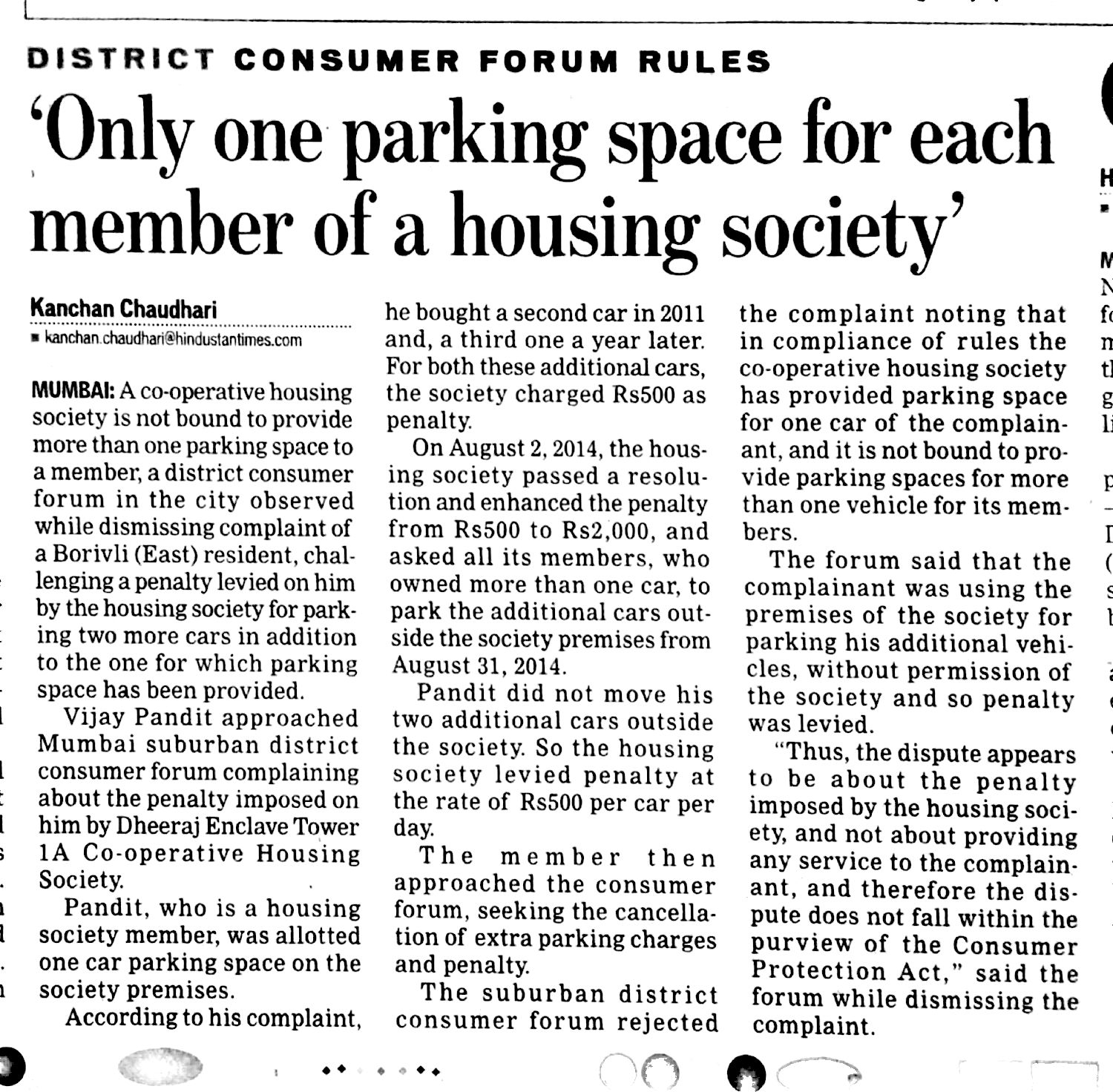
  • 9) QUESTION: WHAT ABOUT PENALTY ON PARKING OFFENSES? (Open, Stilt or whatever):

    ANSWER:

    a) Penalty in a CHS is a “Fine” for violations of the CHS rules & conditions and Resolutions passed in the GB directing the MC to implement the GB directions applicable to them.

    b) Penalty amount may be fixed and decided by the GB and but levied to a member only after after giving opportunity to the member.

    c) However, by virtue of elections and the MCS Bye-Law no 136 of the old Bye-Laws and MCS Bye-Law no 138 of the new Model Bye Laws read as under “The members of the Committee shall be jointly and severally liable for making good any loss which the society may suffer on account of their negligence or omission to perform any of the duties and functions cast on them under the Act, Rules and Bye-laws of the Society.”

    d) In case of dispute of Penalty amount levied by the MC, the member may approach the local Ward Deputy Registrar / Assistant Registrar of Co-operative Housing Societies, for redressal of his grievances.

    As per New Model Bye Laws (as amended in 2009) Bye Law No.166: The general body meeting, after considering the say of the member and after giving him hearing, may levy penalty at the rate fixed by the meeting of the general body of the society but not more than Rs.1000.

    MOFA, is very clear on a part of parking space, stilt and open to sky. Builders do not have any right to sell these spaces, as per lot of judgments. In spite of Supreme Court judgment, some of the builders are known to sell such spaces for lakhs of rupee. If anybody wants to fight, our litigation system is so lengthy, and expansive. As per D.C. Rule builders have to keep 10% (increased to 25% in some areas) parking space in every building project, reserved for the visitors.


1) IN THE HIGH COURT OF JUDICATURE AT BOMBAY APPELLATE JURISDICTION FIRST APPEAL NO. 2182 OF 2007 Nahalchand Laloochand Pvt. Ltd .Appellant Vs. Panchali Co-Operative Housing Society Limited. ..Respondent

2) IN THE SUPREME COURT OF INDIA CIVIL APPELLATE JURISDICTION CIVIL APPEAL NO. 2544 OF 2010 Nahalchand Laloochand Pvt. Ltd. Apellant Vs. Panchali Co-operative Housing Society Ltd. Respondent

Note: The said High Court Order of Nahalchand Laloochand Pvt. Ltd versus Panchali Co-Operative Housing Society Limited was challenged in the Supreme Court of India and the Hon’ble Supreme Court also upheld the Judgment of the Bombay High Court i.e. “Builder cannot sell parking slots in the stilt area as independent flats or garage”

IF THE BUILDER HAS ALREADY SOLD PARKING SPACE:

Under Section 78 of MOF Act, The allotment of parking space/ stilts shall be made by the Managing Committee on the basis of ‘first come first served’ for unsold and available parking spaces. In a judgment by the Maharashtra State Consumer Disputes Redressal Commission authenticated the Cooperative Housing Societies that they can redistribute parking spaces sold and allotted by the Developer after adopting a suitable bye-law. The Commission ruled that the allotment of parking space is a matter that has be decided by the Housing Society. The Commission’s verdict was delivered on February 21, 2012 while deciding a complaint filed by Thane-based elderly couple. The complainants who had purchased a flat in one of the Housing Societies in Thane, had approached the Commission in May last year after they were physically restrained by employees of the Developer from parking their vehicle in a stilt parking space sold to another flat purchaser in the same Society. The complainants alleged that they were thereafter compelled to park their vehicle outside the Society compound.

The Commission ruled that Managing Committee of the Cooperative Housing Society can now decide fresh parking arrangements by cancelling the allotment of parking spaces made by their Builder by adopting a suitable bye-law. The complainants sought compensation from the Developer for selling parking spaces in breach of provisions of the Maharashtra Ownership of Flats Act, 1963. The Developer contended that he had never agreed to sell or allot any parking space to the complainants. The Commission discarded the Developer’s contention, reiterating the settled legal position that the Developer cannot sell or allot any parking space, which forms part of the common amenities of the Housing Society.

IMG-20151006-WA0014

Biotechnology Regulatory Authority of India (BRAI) bill stalled again!

We stopped the Biotechnology Regulatory Authority of India (BRAI) bill again!

Two months ago thousands of emails from us asked Minister of Science and Technology, Jaipal Reddy to stop the bill. Before that we registered our opposition to genetically modified (GM) food by saying ‘No’ to it in an online poll. Now the bill is being reviewed by the Parliamentary Standing Committee on Science and Technology, Environment and Forests. [1]

The BRAI bill is a ploy to silence the opposition to GM crops and food in our country. [2] If cleared, the bill will create an autocratic body that will allow GM crops in our country without checking for safety. It will decide the future of our food and agriculture without even consulting us.

So far we’ve not allowed the BRAI bill to succeed.[3] There is however a strong group of multinational seed corporations, like Monsanto, and politicians who will benefit from this bill and want it to get through. They will use their influence to get this bill cleared in the next Parliament session.

We’ve defeated them for three years and we’ll keep doing that till our food is safe from genetic modification. The fight is still on. Let’s do what we’ve done in the past and save our food from harmful GM technology.

Thanks!

Neha Saigal

Greenpeace India